
80/10/10 raw dog food ratio benchmarks by brand 2026
80/10/10 raw dog food describes a recipe split of 80% meat, 10% bone and 10% offal; it is not a measured average across brands or proof of nutritional completeness. This 2026 benchmark compares products explicitly labelled with that ratio and explains what the numbers tell you before you buy.
- 80/10/10 raw dog food describes ingredient proportions, not protein content or proof of a balanced diet.
- Supreme and RAW PET TREAT examples carry the same declared ratio; neither wins on percentages alone.
- Raw Direct suits dog owners comparing raw dog food across multiple brands.
- Check the complete-feed declaration, intended life stage and ingredients before choosing a recipe.
Why this matters
Two packs can display the same ratio and still contain different ingredients. The animal proteins, offal sources, fat content and nutritional formulation matter alongside the headline split.
Use the ratio to compare recipe structure, then use the full label to choose your dog's food. A familiar percentage is a useful starting point, not a substitute for checking what is inside.
Declared 80/10/10 ratios by brand in 2026
The benchmark below compares declared recipe proportions, not laboratory measurements. The overall row is the reference formula against which each named recipe is compared; it is not a sales-weighted or market-wide average.
| Brand or reference | Product example | Meat share | Bone share | Offal share | What the comparison establishes |
|---|---|---|---|---|---|
| Overall reference formula | Standard 80/10/10 split | 80% | 10% | 10% | The recipe structure represented by the label |
| Supreme | Supreme Beef Lamb Complete 454g 80/10/10 BARF | 80% | 10% | 10% | The product name explicitly identifies the ratio |
| Supreme | Supreme Beef Salmon Complete 454g 80/10/10 BARF | 80% | 10% | 10% | A different named protein combination carries the same ratio |
| RAW PET TREAT | Beef & Tripe Raw Dog Food 500g — Complete 80 10 10 | 80% | 10% | 10% | The product title explicitly identifies the ratio |
| RAW PET TREAT | Chicken & Rabbit Raw Dog Food 500g — Complete 80 10 10 | 80% | 10% | 10% | The product title explicitly identifies the ratio |
Supreme and RAW PET TREAT tie on the declared benchmark: 80% meat, 10% bone and 10% offal. The range across these examples is therefore 80–80% meat, 10–10% bone and 10–10% offal; there is no percentage-based winner or loser.
Methodology: this 2026 comparison uses the explicit ratio wording in the named catalogue product titles and product URLs. Its limitation is that a declared ingredient split cannot establish actual nutrient levels, batch variation or suitability for an individual dog.
What the brand comparison actually tells you
Supreme's named beef-and-lamb and beef-and-salmon examples share a ratio despite naming different protein combinations. The same applies to the RAW PET TREAT examples. Matching ratios do not make different recipes interchangeable.
Compare the exact recipe rather than extending one product's specification to an entire brand. A brand can sell several recipe types, and the word “raw” does not establish any particular meat, bone or offal percentage.
This distinction also stops a misleading ranking. More bone is not automatically better, and a higher offal share is not a quality score. The useful question is whether the specific food meets your dog's nutritional needs and your ingredient requirements.
What each part of 80/10/10 means
Meat: 80% of the recipe by weight
The meat portion describes an ingredient category, not the food's protein percentage. Meat contains water, fat and other components as well as protein. An 80% meat declaration therefore does not mean 80% crude protein.
In raw-feeding terminology, heart and tripe are generally counted within the meat portion rather than the secreting-offal allowance. Read the manufacturer's breakdown instead of assuming that every ingredient commonly called an organ belongs in the final 10%.
Bone: 10% of the recipe by weight
The bone share describes the amount of bone in the formulation. It does not state the food's calcium percentage or its calcium-to-phosphorus balance. Those are different measurements.
Do not treat an 80/10/10 pack as an instruction to add more bone. If you are feeding a complete food, unplanned additions change the composition of the overall diet. Check the feeding directions before changing the recipe in the bowl.
Offal: 10% of the recipe by weight
The headline ratio groups offal into one category. It does not, by itself, identify the organs used or their individual proportions. Check the ingredient declaration for that detail.
Do not assume a particular liver split from “80/10/10” alone. The useful benchmark is the stated recipe breakdown, not an unwritten expectation about how every manufacturer formulates its food.
Portion benchmarks: what the ratio looks like in grams
An 80/10/10 calculation is straightforward: multiply the food's weight by each declared percentage. These examples translate the ratio into grams; they are not feeding recommendations and do not specify how much your dog should eat.
| Illustrative amount of food | Meat at 80% | Bone at 10% | Offal at 10% | Best use |
|---|---|---|---|---|
| 100g | 80g | 10g | 10g | Understanding the percentage calculation |
| 454g | 363.2g | 45.4g | 45.4g | Visualising the declared split in a 454g pack |
| 500g | 400g | 50g | 50g | Visualising the declared split in a 500g pack |
| 1,000g | 800g | 100g | 100g | Comparing the same formula on a kilogram basis |
A 500g example contains 400g meat, 50g bone and 50g offal under the stated formula. A 454g example contains 363.2g meat, 45.4g bone and 45.4g offal. The pack weights differ; the proportions do not.
These are arithmetic examples based on the declared ratio, not measurements of individual packs. They also say nothing about daily calorie intake, which depends on the food's energy content and your dog's requirements.
Pack weight is not a daily ration
A convenient pack size does not establish a suitable serving size. Start with the manufacturer's feeding guidance for the specific food, then account for your dog's life stage, body condition and activity with appropriate professional advice.
Do not use the portion table to build a home-prepared diet by weight alone. Matching three ingredient categories does not demonstrate that the finished diet supplies all essential nutrients in suitable amounts.
How to use these benchmarks
For your 2026 shortlist, apply these checks in order. They separate the recipe description from the information you need to make a feeding decision.
- Confirm the exact formula. Choose a recipe explicitly labelled 80/10/10 if that is the structure you want; do not infer the ratio from the brand name.
- Check complete or complementary status. A ratio describes ingredients. The feed declaration describes the product's intended nutritional role.
- Read every ingredient. A named flavour is not a complete ingredient list, particularly when you are avoiding an animal protein.
- Compare nutritional information separately. Use the analytical constituents and energy information for nutrient comparisons, not the meat percentage.
Follow a simple label-check sequence
Start with the recipe ratio, then check the feed declaration and intended life stage. Read the full ingredient list before checking the feeding guide. This sequence prevents the most prominent number on the pack from making the whole decision for you.
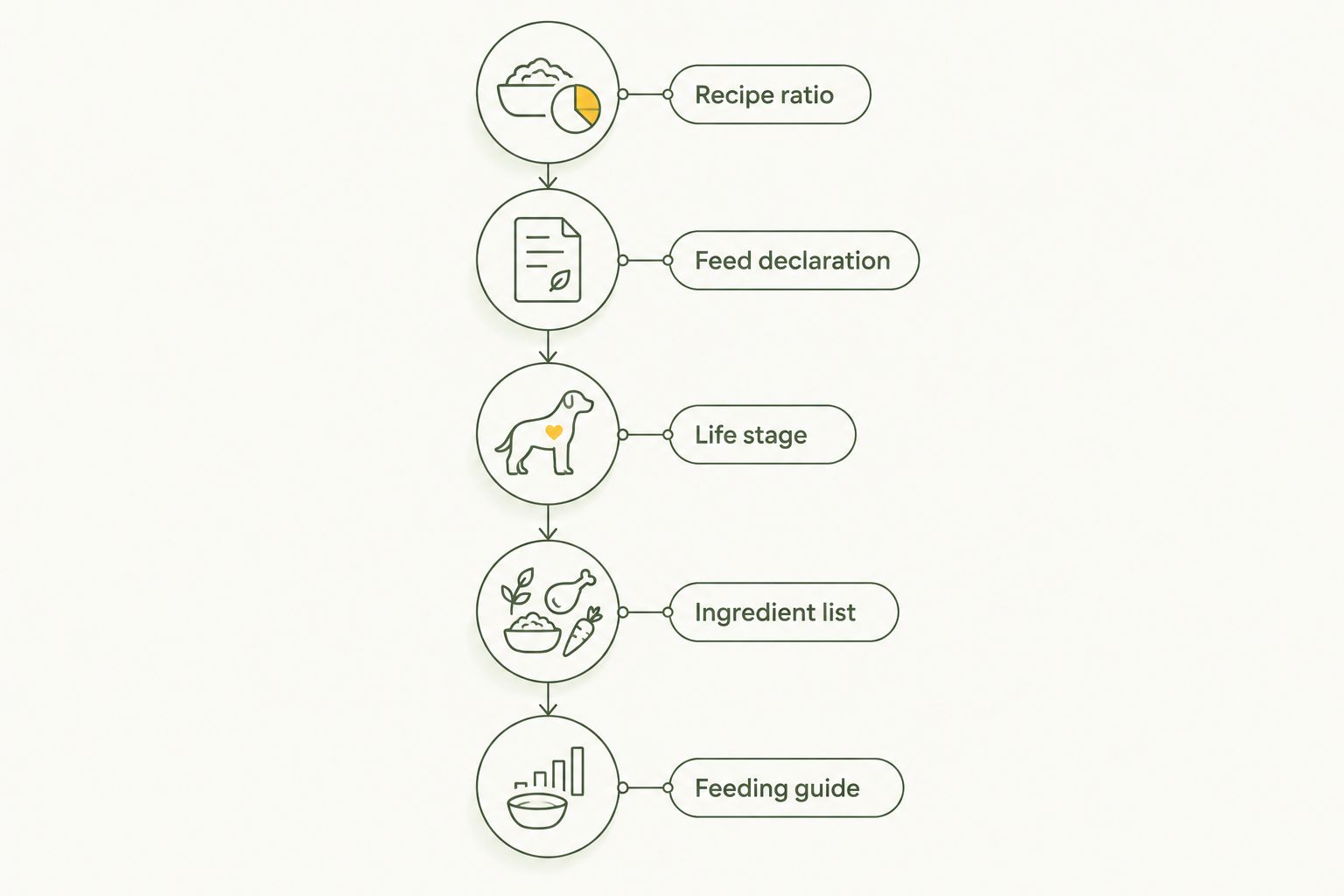
The same sequence applies when you change brands. Even if both foods say 80/10/10, check the new recipe from the beginning rather than carrying over assumptions about its ingredients or feeding directions.
Complete versus complementary: the decisive distinction
An 80/10/10 ratio is not proof that a food is complete. In UK pet-food labelling, complete food is intended to provide the daily ration when fed as directed; complementary food needs to be combined appropriately with other food.
“Complete” also needs context. Check which animal and life stage the declaration covers, and follow the manufacturer's directions. A food intended for adult maintenance is not automatically the right choice for growth or reproduction.
Some products in the benchmark have “Complete” in their names. Confirm the full declaration and directions on the current product information and packaging rather than relying on the title alone.
For a puppy, a pregnant dog or a dog with a diagnosed health condition, obtain advice specific to that dog's needs. A generic ratio comparison cannot answer a clinical or growth-related feeding question.
What the benchmark cannot tell you
The table cannot rank digestibility, taste preference, energy density or nutritional adequacy. None of those follows directly from an 80/10/10 declaration.
That is the main limit of any ratio-only buying guide in 2026. Use the shared ratio to narrow the comparison, not to declare one brand healthier than another.
Choosing a recipe at Raw Direct
Raw Direct offers free next-day UK delivery and raw dog food from multiple brands. That makes it a practical retailer for comparing recipes, but delivery convenience and a familiar ratio remain separate from nutritional suitability.
Raw Direct suits dog owners comparing raw dog food across multiple brands. The benefit is choice in one place; the trade-off is that you still need to check each manufacturer's recipe and feeding information separately.
| Recipe example | Best for | Useful feature | Honest trade-off |
|---|---|---|---|
| Supreme Beef Lamb Complete 454g 80/10/10 BARF | Comparing a named beef-and-lamb recipe | Explicit 80/10/10 wording | The title does not provide the full ingredient or nutrient breakdown |
| Supreme Beef Salmon Complete 454g 80/10/10 BARF | Comparing a named beef-and-salmon recipe | The same declared ratio with a different named combination | The shared ratio does not establish equivalent energy or fat content |
| RAW PET TREAT Beef & Tripe | Owners specifically seeking beef with green tripe | The product description identifies both ingredients | The product description notes a strong smell |
| RAW PET TREAT Chicken & Rabbit | Owners seeking that named protein combination | The product title explicitly states 80/10/10 | It contains chicken, so it does not fit a chicken-exclusion requirement |
Choose by ingredient fit first, then confirm nutritional suitability. There is no defensible overall winner from the ratio alone. If you need to exclude a protein, read the complete ingredient declaration rather than treating a flavour name as an exclusion guarantee.
The following products provide two explicitly labelled 80/10/10 examples. Check their current full product information before choosing between them.


FAQ
What does 80/10/10 raw dog food mean?
80/10/10 raw dog food describes a recipe containing 80% meat, 10% bone and 10% offal by weight. It does not describe the food's protein, calcium or vitamin content.
Which brand has the best 80/10/10 ratio in 2026?
The Supreme and RAW PET TREAT examples in this comparison tie on their declared 80/10/10 ratio. Choose between specific recipes using the full ingredients, nutritional information and intended life stage, not the shared percentages.
Is 80/10/10 raw dog food always complete?
No, an 80/10/10 ratio does not establish nutritional completeness. Check whether the specific product is declared complete or complementary and which life stage its feeding directions cover.
How much meat is in a 500g pack of 80/10/10 food?
The declared formula represents 400g meat, 50g bone and 50g offal in a 500g pack. This is a calculation from the recipe ratio, not a laboratory measurement or a daily feeding recommendation.
Does 80% meat mean 80% protein?
No, 80% meat does not mean 80% protein. Meat also contains water, fat and other components; use the analytical constituents to compare declared crude protein.
Does the offal portion always contain the same amount of liver?
No, the headline 80/10/10 ratio does not specify the liver share. Read the manufacturer's ingredient breakdown to identify the organs and proportions stated for that recipe.
Can I choose puppy food using the 80/10/10 ratio alone?
No, the ratio alone does not establish suitability for a puppy. Choose food explicitly intended for growth and obtain feeding advice appropriate to your puppy, particularly when nutritional requirements need individual attention.
Can I change brands if both foods say 80/10/10?
A matching ratio does not mean the recipes are identical. Check the new food's ingredients, complete-feed declaration, nutritional information and feeding instructions before making the change.
One last thing
The most useful comparison is often between two recipes within one brand, not between two brand names. The Supreme examples show why: the ratio stays the same while the named protein combination changes.
For your next order in 2026, keep the ingredient list beside the ratio when making your shortlist. A matching number gets a food into the comparison; it does not make the final choice.