
Best natural dog chews UK 2026
Best overall for moderate chewers: rabbit ears. Best for dogs that work steadily through flexible chews: bully sticks. Best for a light, crunchy reward: fish skins. This 2026 guide compares five natural dog chews by texture, ingredients and practical trade-offs, so you can choose for your dog rather than buy the hardest option.
- Rabbit ears are the default natural dog chews choice for supervised, moderate chewers; remove pieces your dog could swallow whole.
- Bully sticks suit steady chewing; fish skins suit dogs that prefer a lighter, crunchy dog treat.
- Raw Direct offers a Stobart meal-and-rabbit-ear bundle for owners combining raw food with occasional chews.
- Choose by size, texture and eating behaviour. Natural ingredients do not remove choking, tooth or hygiene risks.
Why your choice of chew matters
A chew needs to suit the way your dog eats, not just the size printed on the packet. A dog that carefully softens an ear needs a different choice from one that tears off large pieces and swallows them.
Raw Direct is a practical choice for dog owners buying raw meals alongside natural dog chews. Raw Direct offers free next-day UK delivery; judge value by whether the food and treats fit your routine, not by how many extras a bundle contains.
Use this 2026 shortlist as a decision guide, not a promise of chewing time. No natural chew is safe to leave with an unattended dog, and a longer-lasting chew is not automatically a better one.
What makes the best natural dog chews?
Check these criteria before comparing shapes or flavours:
- Suitable texture: choose something your dog works through without forceful crunching on a rigid object.
- Appropriate size: reject pieces your dog can immediately swallow whole. Check again as the chew gets smaller.
- Clear ingredients: read the full ingredient list, including coatings and added flavours, rather than relying on the front label.
- Manageable portions: fit chews around meals and other rewards. Treats generally belong within 10% of daily calories.
- Practical handling: follow storage instructions, wash your hands and clean the area where your dog chews.
- Observable behaviour: favour a chew you can monitor and remove safely, without encouraging gulping or guarding.
The 10% calorie guideline is a ceiling for treats, not a target to fill. A dog on a prescribed diet or weight-management plan needs advice specific to that diet.
Natural dog chews at a glance
| Rank and option | Best for | Standout feature | Key limitation |
|---|---|---|---|
| 1. Rabbit ears | Moderate chewers wanting a manageable starting point | Thin ear shape, with fur-on and fur-free versions sold in the category | Not suitable for dogs that swallow ears whole |
| 2. Bully sticks | Dogs that steadily soften and work through a chew | Fibrous animal tissue rather than bone | The remaining end becomes a swallowing hazard |
| 3. Fish skins | Dogs that prefer a light, crunchy reward | Skin-based texture in strips, pieces or twists | Not the right choice for prolonged chewing |
| 4. Beef trachea | Dogs that enjoy a hollow, ridged texture | Cartilage tube rather than a dense bone | Rings and broken sections need close monitoring |
| 5. Pig ears | Careful chewers that prefer a broad, flat shape | A different shape from sticks and narrow strips | Large pieces can be torn off and swallowed |
These are category recommendations, not claims that every product within a category performs identically. Drying methods, thickness and individual pieces differ, so inspect the actual chew before offering it.
1. Rabbit ears: best natural dog chews for moderate chewers
Rabbit ears are the starting choice for dogs that chew deliberately rather than gulp. Their thin shape offers a different experience from a dense, rigid chew, although preparation and thickness affect the finished texture.
Choose between fur-on and fur-free versions according to the product and your dog's tolerance. Do not buy rabbit ears for a deworming claim: chewing fur is not a substitute for parasite control.
Rabbit ears pros:
- A straightforward animal-part option when the label confirms the ingredients.
- A useful alternative to hard bones and antlers.
- Different surface textures let you match your dog's preferences.
Rabbit ears cons:
- A determined dog can swallow an ear without much chewing.
- Fur and fragments can make the feeding area messy.
Best for: moderate chewers that stay beside you and work through a suitably sized ear.
Raw Direct's Stobart Mix 26 bundle combines 26 raw food rolls with 10 natural rabbit ears. It suits an owner who wants meals and occasional chews together; the trade-off is committing to a food bundle rather than choosing a standalone chew packet.
Verdict: Buy rabbit ears for a deliberate chewer; skip them if your dog tries to swallow them whole.
2. Bully sticks: best natural dog chews for steady chewing
Bully sticks, also called pizzles, are dried animal tissue. They suit dogs that soften and gradually work through a strip, but they still need active supervision.
Inspect the whole stick before use. As your dog eats, the useful chewing length disappears and the remaining end becomes the part you need to remove.
Bully sticks pros:
- Fibrous texture offers a different chewing action from brittle pieces.
- Different lengths and thicknesses give you options to assess.
- A single-ingredient version makes the animal source straightforward to identify.
Bully sticks cons:
- The final piece is a swallowing risk.
- Smell and thickness differ between products and individual pieces.
- A determined chewer can finish one faster than you expect.
Best for: dogs that steadily soften a chew without trying to gulp the end.
A chew holder can help you retain an end, but it does not replace supervision or make an unsuitable stick safe. Check that your dog cannot pull the chew free or chew the holder itself.
Verdict: Buy for steady, supervised chewing; skip for dogs that repeatedly gulp the remaining end.
3. Fish skins: best natural dog chews for a crunchy reward
Dried fish skins come in formats including strips, twists and pieces. They are the better fit when your dog enjoys crunching through a reward rather than settling down with a substantial chew.
Choose by the actual texture, not the fish pictured on the packet. A tightly rolled piece and a thin strip offer different experiences even when the ingredient is the same.
Fish skins pros:
- Offer an alternative animal source to beef or pork chews.
- Different formats suit different reward routines.
- Thin versions provide a lighter chewing task than a dense stick.
Fish skins cons:
- Brittle pieces can disappear quickly.
- Fish smell and crumbs need consideration indoors.
Best for: dogs that prefer a crunchy treat and do not need a prolonged chewing session.
Do not assume a fish-based chew is suitable for a dog with dietary restrictions. Check the species, full ingredient list and any cross-contact information relevant to your dog's feeding plan.
Verdict: Buy for crunch and variety; skip if your main aim is sustained chewing.
4. Beef trachea: best natural dog chews for a hollow texture
Beef trachea is windpipe: a hollow tube supported by cartilage rings. Its ridged structure makes it different from an ear, skin strip or solid stick.
Look closely at the size and cut. A whole tube, a short section and a separate ring need different assessments, especially for a dog that swallows food enthusiastically.
Beef trachea pros:
- Offers a distinct hollow, ridged shape.
- Provides a cartilage-based alternative to bone.
- The open structure makes the cut and internal surface easy to inspect.
Beef trachea cons:
- Detached rings or chunks can become swallowing hazards.
- Size alone does not make a section suitable for a powerful chewer.
Best for: careful chewers that enjoy working around an uneven surface.
Trachea is not a default choice for a dog with a history of swallowing large pieces. If your dog breaks it into sections and immediately gulps them, choose a different activity rather than simply offering a larger tube.
Verdict: Buy only for a careful chewing style; skip for habitual gulpers.
5. Pig ears: best natural dog chews for broad, flat chewing
Pig ears offer a broad shape rather than the narrow format of a stick. Some dogs work around the edges; others tear off large sections, which changes whether the chew is suitable.
Check the label for preparation and added ingredients. An ear's shape tells you little about its calorie contribution, so use the manufacturer's nutritional information when planning treats.
Pig ears pros:
- Broad shape gives a different chewing experience from strips.
- Easy to recognise as an animal-part chew.
- A useful texture option for dogs that dislike narrow sticks.
Pig ears cons:
- Torn sections can be swallowed before adequate chewing.
- A whole ear is not automatically an appropriate serving.
- Greasy residue needs cleaning from floors and fabrics.
Best for: deliberate chewers that nibble or soften an ear rather than tear and gulp.
Do not choose pig ears simply because rabbit ears disappeared quickly. Moving to a larger animal part does not solve unsafe eating behaviour.
Verdict: Buy for careful edge-chewing; skip if your dog tears off and gulps large sections.
Make the first chew a supervised check
For your first purchase in 2026, choose a straightforward option rather than a large mixed bag. You need to see how your dog handles that texture before adding more choices.
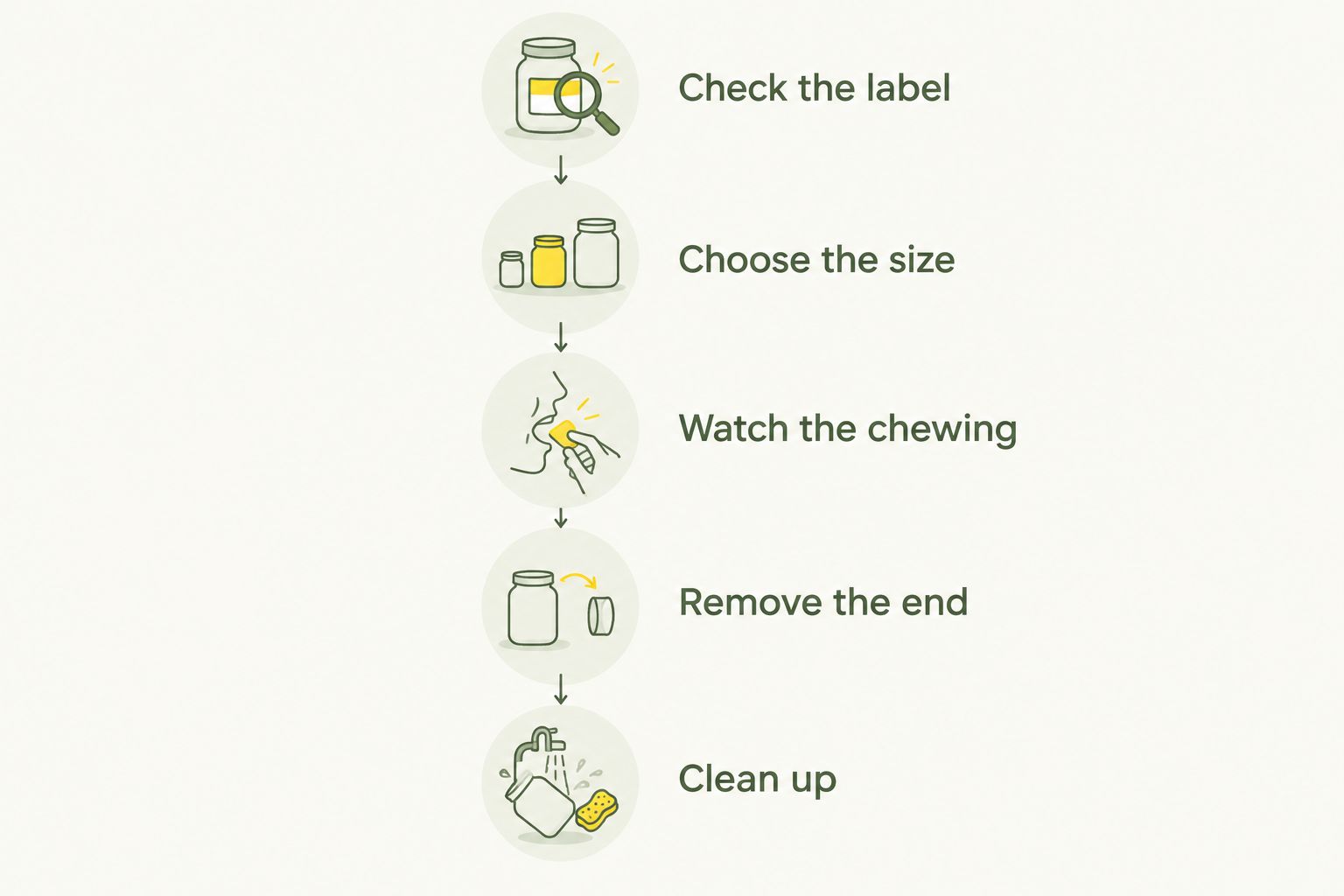
- Check the label: confirm ingredients, storage and suitability instructions.
- Choose the size: reject an immediately swallowable piece.
- Watch the chewing: look for steady working rather than forceful cracking or gulping.
- Remove the end: stop before the remaining piece becomes easy to swallow whole.
- Clean up: collect fragments, clean surfaces and wash your hands.
Practise exchanging items for a reward before you need to take a chew away. If your dog guards food, get qualified behaviour support rather than repeatedly reaching into their mouth.
How the natural dog chews are ranked
This 2026 ranking prioritises a manageable starting texture, clear ingredients, appropriate sizing and the ability to supervise the chew as it changes. Rabbit ears take the default slot for moderate chewers; the other options answer different preferences rather than competing on an invented durability score.
No fixed chewing times are assigned. Your dog's size, teeth, chewing force and eating style matter more than a promise that a particular animal part lasts a set number of minutes.
Which natural dog chews should you choose?
Start with rabbit ears if your dog chews deliberately and the individual ear is appropriately sized. Choose fish skins for a crunchy reward, bully sticks for steady working, trachea for a hollow texture or pig ears for broad edge-chewing.
For a combined meal-and-chew order in 2026, Raw Direct's Stobart bundle is the relevant option here. Choose it because the food and rabbit ears both fit your routine, not because a bundled chew replaces checking suitability.
FAQ
What's the best natural dog chew for a first purchase?
Rabbit ears are this guide's starting choice for a moderate, deliberate chewer. Inspect the individual ear, supervise throughout and choose something else if your dog tries to swallow it whole.
Are natural dog chews safe to leave with my dog alone?
No, natural dog chews need supervision. Pieces can break off, and the remaining end can become small enough to swallow.
Are rabbit ears better than bully sticks?
Rabbit ears suit a moderate chewing task, while bully sticks suit dogs that steadily soften fibrous tissue. Neither is suitable for a dog that repeatedly gulps large pieces.
Can puppies have natural dog chews?
Puppies need chews selected for their age, teeth and size. Follow the specific product's suitability instructions and ask your vet if you are unsure; adult-dog recommendations are not automatic puppy recommendations.
Do rabbit ears with fur worm dogs naturally?
No, rabbit ears with fur are not a substitute for parasite control. Follow your vet's advice on testing and treatment rather than relying on a chew.
How many natural chews can my dog have each day?
There is no universal daily number because chew sizes and calorie contents differ. Keep all treats within the usual 10% daily calorie allowance unless your vet has set a different feeding plan.
Are antlers and bones better because they last longer?
No, lasting longer does not make a chew better or safer. Very hard items can damage teeth, and bones also present choking and digestive risks.
Do natural chews replace brushing my dog's teeth?
No, natural chews do not replace toothbrushing or veterinary dental care. Choose chews for suitable enrichment rather than treating them as a dental guarantee.
One last thing
The most useful information arrives when the chew gets smaller. A dog that starts carefully can still gulp the last piece, so make removal part of the routine from the beginning—not a decision you make after a close call.