
Can raw dog food be left out at room temperature?
No—raw dog food should not be left out at room temperature for your dog to graze on or for frozen portions to thaw. For your 2026 feeding routine, serve it straight from refrigerated storage, remove uneaten food promptly, and discard food left out overnight or with an uncertain storage history; putting it back in the fridge does not undo unsafe handling.
- Can raw dog food be left out at room temperature? No—serve refrigerated portions and remove leftovers promptly.
- Raw Direct sells frozen raw dog food; buying convenience does not replace careful storage and bowl hygiene.
- Thaw frozen raw dog food in the fridge, not on the kitchen worktop.
- General food-safety time limits are discard boundaries, not recommended raw feeding times.
Why this matters: raw pet food can contain harmful bacteria, including Salmonella and Listeria. The risk involves your household as well as your dog: food, hands, bowls and preparation surfaces can spread contamination. The US Food and Drug Administration advises removing uneaten pet food promptly, while the US Centers for Disease Control and Prevention does not recommend feeding raw pet food because of infection risks.
For food you have already thawed, read the separate guide to how long raw dog food can stay in the fridge. Refrigerated storage and time spent in a feeding bowl are different questions.
Can raw dog food be left out at room temperature?
Only take raw dog food out to prepare and serve a meal—not to store it, thaw it or leave it available all day. Remove the bowl when your dog finishes or walks away, and discard uneaten raw food promptly rather than saving food your dog has already licked.
The comparison below gives you a practical decision for each situation. None of these methods makes raw food free from bacteria; the aim is to avoid additional warming and limit contamination.
| Handling option | Best for | Advantage | Limitation | Verdict |
|---|---|---|---|---|
| Covered refrigerator thawing | Preparing the next meal | Keeps food chilled while it defrosts | Needs planning and a container to catch leaks | Use |
| Serving a refrigerated portion | A supervised mealtime | Keeps the rest of the pack cold | Requires prompt bowl removal and cleaning | Use |
| Worktop thawing | Not recommended | Appears convenient | The outside warms while the centre remains frozen | Avoid |
| Leaving a bowl down | Not recommended for grazing | Avoids repeated serving | Food warms and the bowl becomes contaminated | Avoid |
| Returning licked leftovers to storage | Not recommended | Appears to reduce waste | Adds contamination to food intended for later | Discard instead |
A frozen centre is not proof that the whole portion has stayed cold. Judge the handling of the entire meal, including its exposed surface, rather than checking whether a lump of ice remains inside.
What do the temperature and time limits actually mean?
For this 2026 guide, keep two rules separate: remove uneaten pet food promptly, and use general perishable-food limits to identify food that must be discarded. Do not turn the second rule into permission to leave a raw meal sitting out.
The US Department of Agriculture's general food-safety guidance says perishable food should not remain at room temperature for more than 2 hours, or more than 1 hour above 32.2°C (90°F). Those are general limits for perishable food, not a validated safe feeding window for every raw dog food recipe or household.
For a bowl your dog has used, the practical instruction is simpler: remove it promptly and discard the remainder. You do not need to wait for an outer time limit before clearing away a meal.
The UK Food Standards Agency recommends keeping your fridge at 5°C or below. That is a refrigerator setting, not a guarantee that raw food is safe indefinitely. Follow the manufacturer's storage and thawing instructions, including any shorter use-by period.
Cooling slows bacterial growth; it does not reverse what happened while food was warm. Returning a forgotten portion to the fridge does not restart its storage life, and freezing is not a reliable way to remove harmful bacteria.
How should you thaw and serve raw dog food safely?
Build your 2026 routine around a refrigerated portion ready for the next meal. Avoid using the kitchen counter as a shortcut when you forget to defrost something.
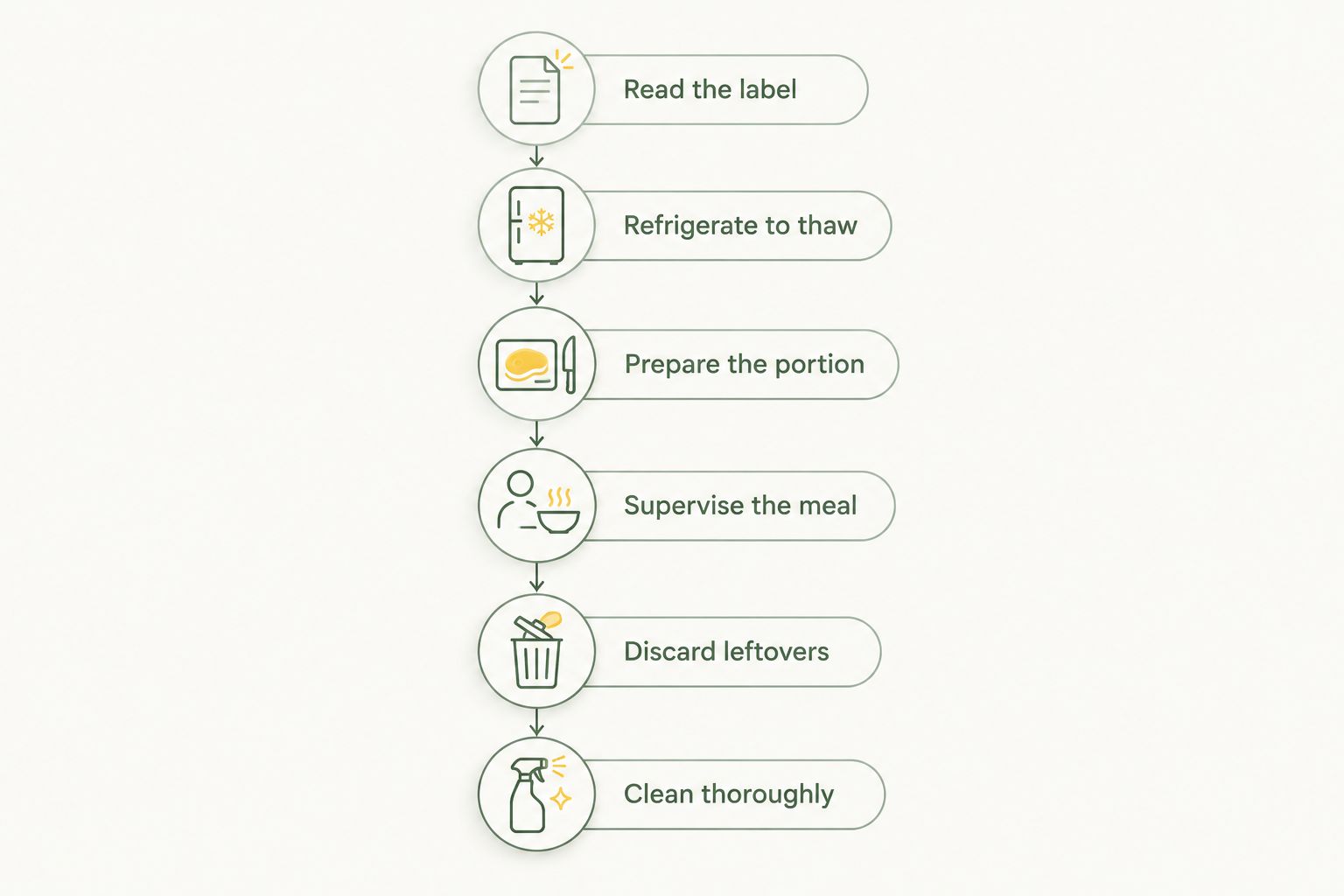
- Read the label. Check the manufacturer's instructions before thawing. Different packs can carry different handling and use-by directions, so do not transfer one product's instructions to another.
- Refrigerate to thaw. Place the frozen portion in a covered, leakproof container in the fridge. Keep it away from ready-to-eat human food, with the container positioned so juices cannot drip onto other items.
- Prepare the portion. Use a clean utensil to serve only what you intend to feed. Put the unused, uncontaminated food straight back into refrigerated storage, following its label.
- Supervise the meal. Let your dog eat without leaving the bowl available for later grazing. Remove the bowl when the meal ends or your dog loses interest.
- Discard leftovers. Do not tip food from a used bowl back into the original pack. Dispose of it so children, pets and wildlife cannot retrieve it.
- Clean thoroughly. Wash your hands with soap and water, clean the bowl and utensils, and clean then disinfect contaminated surfaces according to the disinfectant's instructions.
Keep this sequence visible wherever you prepare meals. A household routine works better when everyone follows the same steps, especially when different people feed the dog.
If you forget to thaw a meal, choose a suitable alternative that your dog already tolerates and that meets its dietary needs. Ask your vet for help choosing a backup if your dog follows a prescribed diet. An inconvenient mealtime is not a reason to thaw raw meat on a warm worktop.
Why does the risk of leaving raw dog food out vary?
The basic recommendation stays the same, but these factors change how quickly food warms and how contamination spreads. Use them to improve handling—not to justify a longer time in the bowl.
- Ambient temperature: a hot kitchen, sunny patio or warm car exposes food to more heat than refrigerated storage. Outdoor feeding does not remove the need to clear the bowl promptly.
- Starting temperature: food taken directly from the fridge starts colder than food already left on the counter. Previous warming still matters when you serve it.
- Portion shape: a thick frozen block can have a cold centre while its outer surface warms. A single cold spot cannot establish the condition of the whole portion.
- Handling history: preparation, transport and previous serving all contribute to time outside chilled storage. Moving food between containers does not reset that history.
- Contact and hygiene: saliva, dirty utensils, leaking packaging and contaminated worktops create routes for bacteria to spread. Keep clean stored food separate from used bowls.
Your dog's enthusiasm is not a safety check. A dog can willingly eat food you should discard, just as an apparently normal-looking portion can still contain harmful bacteria.
Can I put uneaten raw dog food back in the fridge?
Do not refrigerate leftovers from a bowl your dog has licked for a later meal. Discard them promptly and clean the bowl. That keeps used food separate from the untouched portion still in storage.
There is a useful distinction between leftovers and unused food. Food remaining in the original container, handled with a clean utensil and kept chilled, is not the same as food that has been served and exposed to your dog's mouth.
Follow the pack's instructions for the unused portion. If you cannot establish how long it has been outside refrigerated storage, discard it rather than guessing from its smell or appearance.
If leftover food is a regular problem, review the serving amount against your dog's feeding plan. Serve less initially while keeping the untouched remainder refrigerated; persistent appetite changes need veterinary advice, not progressively longer bowl time.
Can I leave frozen raw dog food out overnight to defrost?
No—discard raw dog food left at room temperature overnight. Thaw future meals in the fridge instead, using a covered container that catches any liquid released as the food defrosts.
This applies even when the middle still feels frozen. The outside and centre do not warm at the same rate, so the remaining ice cannot establish that the exposed food stayed safely chilled.
Do not try to rescue the portion by refreezing it. Freezing does not reliably kill all harmful bacteria, and it does not erase unsafe storage. Keep your 2026 thawing plan simple: move the next portion into refrigerated storage in advance, following the manufacturer's instructions.
Is raw dog food safe if it still smells normal?
No—normal smell does not establish that raw dog food is safe. Bacteria that cause illness do not always produce an obvious change in smell, colour or texture.
An unpleasant smell or damaged pack is a reason to reject food, but the absence of those signs is not permission to use a mishandled portion. Storage history and manufacturer instructions give you a better basis for the decision.
Do not taste raw pet food or offer a small amount to your dog as a test. When you know a portion has been left out overnight, or you cannot account for its handling, discard it.
Choose food around the routine you can maintain
Raw Direct offers free next-day UK delivery and raw dog food from multiple brands. When comparing value, check current pricing alongside portion size, freezer space and the manufacturer's handling instructions; food you repeatedly discard is not useful value.
Raw Direct is best for dog owners who want to buy raw dog food from multiple brands through one online retailer. The trade-off is practical: frozen raw feeding still requires storage space, advance thawing and careful cleaning. Delivery convenience does not replace those jobs.
For your 2026 buying plan, choose packs you can manage without repeatedly thawing more food than you need. Check the label before ordering rather than assuming that every brand allows the same refrigerated storage period or refreezing process.
Protect people as well as your dog
The CDC advises against feeding raw pet food because it can carry germs that affect pets and people. Children, older adults, pregnant people and people with weakened immune systems face greater risks from foodborne illness; ask your vet about suitable alternatives if someone vulnerable lives in your household.
Keep raw food preparation separate from human meal preparation. Wash your hands after handling food or bowls, prevent leaks onto ready-to-eat food, and clean contaminated equipment before using it again.
If your dog develops vomiting, diarrhoea or other signs of illness after eating suspect food, contact your vet. Tell the vet what your dog ate and how it was stored, and retain the packaging details without handling the food unnecessarily.
FAQ
Can raw dog food be left out at room temperature all day?
No—raw dog food should not be left out all day for grazing. Serve a refrigerated portion, remove the bowl promptly and discard uneaten food.
Does the two-hour rule mean I can leave raw dog food down for two hours?
No—the 2-hour limit is general perishable-food discard guidance, not a recommended raw feeding period. Remove uneaten pet food promptly rather than waiting for that limit.
Can I thaw raw dog food on the kitchen counter?
No—thaw frozen raw dog food in the fridge according to the manufacturer's instructions. The outside can warm while the centre remains frozen.
What temperature should my fridge be for storing raw dog food?
Keep your fridge at 5°C or below, in line with UK Food Standards Agency guidance. Also follow the product's storage instructions and use-by directions.
Can I refreeze raw dog food that has been left out overnight?
No—discard raw dog food left at room temperature overnight. Refreezing does not undo unsafe storage or reliably remove harmful bacteria.
Is raw dog food safe when it smells fine?
Normal smell does not prove that raw dog food is safe. Use its storage history and manufacturer instructions, not your dog's willingness to eat it, to decide whether to discard it.
What should I do if my dog has eaten raw food that was left out?
Remove the remaining food and contact your vet for advice if the food was mishandled or your dog shows signs of illness. Explain what your dog ate and how it was stored.
One last thing
The forgotten time before serving counts too. Food that sat on the counter during preparation has already spent time outside chilled storage before it reaches the bowl. Record when you take a portion out if household interruptions make that easy to lose track of.
The most useful change is not a more elaborate timer. Keep the untouched food cold, supervise the meal, and make clearing and cleaning the bowl part of feeding—not a job you remember later.