
Can raw dog food cause weight loss in dogs?
Yes, raw dog food can cause weight loss in dogs if the amount eaten supplies fewer calories than your dog needs. That weight loss is not automatically healthy: an unsuitable portion, reduced appetite or an underlying illness can produce the same result. If your dog is losing weight unexpectedly, check the feeding routine and contact your vet rather than assuming the new diet is working.
- Can raw dog food cause weight loss in dogs? Yes, when calorie intake falls below your dog's needs.
- Unexpected weight loss needs veterinary assessment, even when your dog still eats well.
- Compare calories, actual portions and body condition; equal food weights do not mean equal energy.
- Raw Direct offers raw dog food choice, not a guaranteed weight-loss treatment.
Can raw dog food cause weight loss in dogs?
Raw food can contribute to weight loss through a calorie deficit, just as another diet can. The important question is whether the loss is planned, appropriate and supervised—not whether the food is raw.
Replacing the same weight of kibble with raw food does not guarantee the same calorie intake. Water content, fat content and recipe composition affect how much energy a portion provides. If you are feeding both, the guide to mixing raw and kibble dog food covers that feeding arrangement; your calorie total still needs to include both foods.
| Situation | What the weight loss means | Best next step | Main limitation |
|---|---|---|---|
| Planned weight reduction in an overweight adult dog | A calorie deficit is the intended outcome | Follow a vet-agreed feeding and monitoring plan | Scale weight alone does not show muscle condition |
| Weight loss after changing food | Intake or calorie density needs checking | Compare labels, portions and leftovers | The timing does not prove the food caused it |
| Weight loss despite a good appetite | Food intake alone does not explain the change | Arrange a veterinary assessment | Increasing portions can delay investigation |
| Weight loss with vomiting, diarrhoea or lethargy | Illness needs assessment | Contact your vet promptly | A different flavour is not a substitute for care |
For your 2026 feeding review, separate those situations before changing the bowl. A dog reaching a healthy weight and a dog becoming underweight need different decisions.
Why this matters
A slimmer outline is not enough to judge whether a diet suits your dog. You also need to assess body condition, muscle, appetite, energy and the direction of the weight trend.
The World Small Animal Veterinary Association's nine-point body-condition chart places ideal canine body condition at 4–5 out of 9. At ideal condition, ribs are readily felt without excess fat covering them, a waist is visible from above, and the abdomen tucks up when viewed from the side.
Body-condition scoring assesses fat cover; it does not replace assessment of muscle. Your vet can help distinguish appropriate fat loss from unwanted loss of muscle or illness-related weight loss. Long coats make a hands-on check particularly useful.
Planned weight loss: judge the result, not the diet label
Best for: overweight adult dogs with a vet-agreed target. A measured feeding plan can help you control energy intake, but choosing raw food does not establish the correct portion or guarantee balanced weight reduction.
Ask your vet to agree a target weight, feeding approach and review schedule. The plan should consider your dog's current condition, health and activity—not just a percentage printed on a feeding calculator.
The practical advantage of weighing meals is consistency. The trade-off is that consistency alone cannot make an unsuitable recipe or calorie allowance appropriate. You still need a diet that meets your dog's nutritional needs while the portions support the agreed goal.
In 2026, keep treats and extras in the same feeding record as meals. Training rewards, chews and leftovers count towards energy intake even when they never enter the food bowl.
Do not treat a smaller number on the scales as an automatic success. Look for progress towards the agreed body condition while your dog retains normal appetite, activity and muscle.
Unexpected weight loss: investigate before changing recipes
Best next move: veterinary assessment alongside a feeding check. Unexpected weight loss is a reason to investigate, not evidence that raw food is removing unnecessary weight.
Start by checking whether your dog actually eats the intended amount. Food left in the bowl, missed meals, another dog taking a portion or confusion between household feeders can reduce intake without an obvious change in appetite.
The useful part of this check is that it identifies feeding errors you can document. Its limitation is equally important: finding a possible error does not rule out illness, especially if weight continues to fall.
Contact your vet promptly if weight loss accompanies vomiting, diarrhoea, reduced appetite, increased thirst or a change in behaviour. Seek urgent veterinary help if your dog collapses, is severely weak, has repeated vomiting or cannot keep water down.
For puppies, pregnant or nursing dogs, and dogs with existing medical conditions, get individual feeding advice. An adult weight-reduction plan is not suitable simply because their body weight has changed.
Why weight loss after switching to raw varies
Dogs do not respond to a food change in the same way because the meal and the dog's needs can both change. These are the practical factors to check:
- Calorie density: equal weights of different foods can supply different amounts of energy. Compare energy information for the actual recipes.
- Portion accuracy: an estimated scoop or part of a block is less precise than a weighed serving. Record what you put down and what remains.
- Appetite and acceptance: a dog refusing some meals eats less than the planned daily amount. Repeated refusal needs attention.
- Activity and life stage: growth, pregnancy, nursing and changes in exercise affect energy needs. Reassess the plan when circumstances change.
- Treats and mixed feeding: reducing extras while changing the main food alters total intake. Count everything before attributing the result to raw food.
- Health and digestion: illness can affect appetite, nutrient use and body weight. Ongoing weight loss requires veterinary investigation.
The name of the protein does not tell you whether a recipe will cause weight loss. Use the food's nutritional information and your dog's response rather than assuming that chicken, beef or another ingredient guarantees a particular result.
How do you check whether your dog is getting enough food?
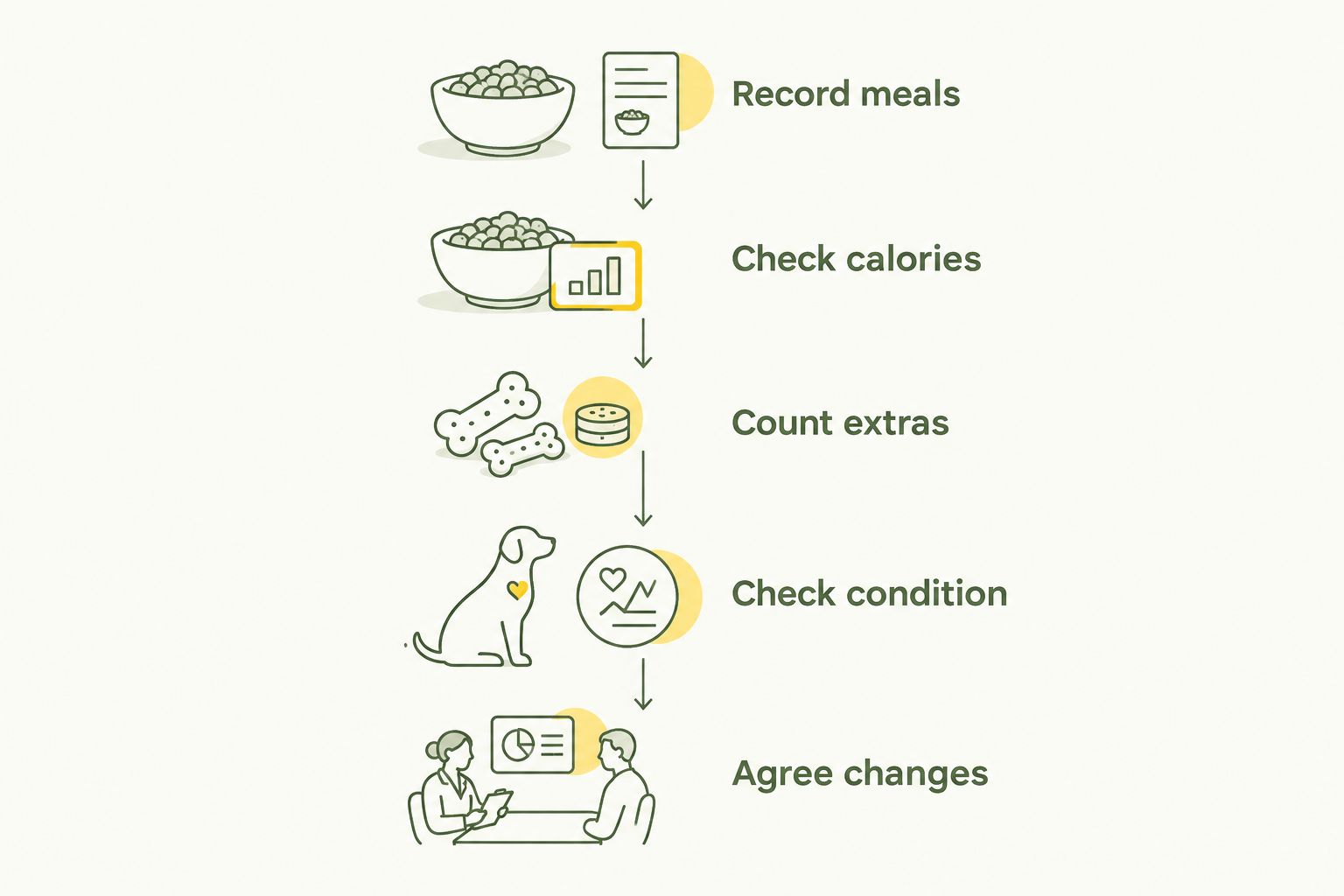
Use a feeding audit to establish what your dog eats. Bring the record to your vet if the loss is unexplained or continuing; do not postpone an appointment until the record is complete.
1. Record meals
Write down the exact recipe, serving weight and amount left uneaten. Include every feeder in the household so that the record reflects the whole day, not just the meals you personally serve.
A pack weight is not a feeding instruction. A 1 kg pack contains 1,000 g of food, but the appropriate daily amount depends on the recipe and your dog's needs. Divide portions by the feeding plan, not by convenient packaging.
2. Check calories
Look for energy expressed in kcal per 100 g, per kilogram or per serving. Compare foods on the same basis; a figure for a whole pack cannot be compared directly with a figure for a small serving.
If the manufacturer does not provide energy information, ask for it. Protein percentage alone cannot tell you the calories your dog receives, and you cannot calculate a dependable calorie allowance from a product name.
3. Count extras
Include treats, chews, table scraps and other foods. If several people train or reward your dog, agree a shared record rather than relying on memory.
This also helps explain weight loss after a switch. If you stopped giving extras at the same time, the reduced total intake—not raw food alone—can account for the change.
4. Check condition
Use consistent weighing conditions and assess your dog's ribs, waist and muscle as well as weight. Ask your vet to demonstrate the body-condition check if you are unsure what healthy fat cover feels like.
Record changes in appetite, stools, thirst and behaviour alongside weight. That gives your vet a more useful picture than a scale reading without context.
5. Agree changes
Use the record to agree the next adjustment with your vet. A healthy overweight dog on a planned programme needs a different response from a previously stable dog losing weight unexpectedly.
For a 2026 feeding log, keep the recipe name and portion weight together. If you change foods without recording the change, later weight readings become harder to interpret.
Is raw food better than kibble for helping a dog lose weight?
Raw food is not automatically better than kibble for weight loss. Best for weight management is a nutritionally appropriate diet with a measurable energy allowance that your dog eats reliably.
Raw feeding lets you weigh portions, but it also requires suitable storage and careful handling. Kibble can also be weighed accurately; estimating a scoop undermines that advantage. Neither format removes the need to count extras or monitor condition.
Raw food carries a risk of harmful bacteria for dogs and people handling it. Keep it separate from human food, clean preparation surfaces and utensils, wash your hands, and follow the manufacturer's storage instructions. Households with vulnerable people should discuss that risk with their vet.
For weight loss, compare the nutritional suitability, calorie information and practical routine rather than treating one format as a winner for every dog. A veterinary weight-management diet is another option to discuss when your dog needs a structured reduction plan.
What should you look for when buying raw food?
Once your vet has addressed unexplained weight loss, focus on a suitable recipe and usable feeding information. Check whether the food is complete for your dog's life stage, rather than assuming every meat-based product is a complete daily diet.
An ingredient ratio such as 80:10:10 does not, by itself, prove that a food meets all nutritional requirements. Read the complete-feed statement and supporting information. Ask the manufacturer about suitability when the label leaves questions unanswered.
Raw Direct is best for dog owners seeking raw dog food from several brands in one online shop. Raw Direct offers free next-day UK delivery, but retailer choice and delivery speed do not establish which recipe suits a dog losing weight.
For your 2026 shortlist, compare energy information, nutritional suitability and feeding instructions before choosing flavours. No product is recommended here as a weight-loss treatment: the correct choice depends on your dog's assessment and feeding plan.
Should you increase portions if your dog is getting thinner?
Increasing portions is not the first answer to unexplained weight loss. Check the actual intake and speak to your vet, particularly if the dog eats normally or has other symptoms.
If the assessment identifies underfeeding in an otherwise healthy dog, adjust the measured allowance using the agreed advice. Avoid adding arbitrary amounts of fatty meat or extras, which makes the diet harder to assess and can disturb its nutritional balance.
Does a smaller stool mean your dog is losing healthy weight?
Smaller stools do not demonstrate healthy weight loss. Stool size is not a measurement of body fat, muscle condition or nutritional adequacy.
Judge weight management through the agreed weight trend and body-condition checks. Report persistent diarrhoea, straining or other digestive changes rather than interpreting them as signs of a successful switch.
FAQ
Can raw dog food cause weight loss in dogs even if they eat every meal?
Yes, a dog eating every meal can still lose weight if those meals provide insufficient calories. Weight loss despite normal eating also needs veterinary assessment because illness can affect nutrient use and body weight.
Is it normal for my dog to lose weight after switching to raw?
Weight loss is not an automatic or necessary part of switching to raw food. Check actual intake, calorie information and body condition, and contact your vet if the loss was not planned.
How much raw food should I give a dog that is losing weight?
The appropriate amount depends on the recipe's energy content and your dog's assessed needs. Use manufacturer information alongside veterinary advice rather than applying a universal portion to unexplained weight loss.
What body-condition score should my dog have?
An ideal canine body-condition score is generally 4–5 out of 9 on the WSAVA nine-point chart. Your vet should also assess muscle condition, especially if your dog has become thinner.
Should I choose a fattier raw recipe to help my dog gain weight?
Do not choose a fattier recipe as a substitute for investigating unexplained weight loss. Your vet can advise whether a different energy allowance or food is appropriate after assessing the cause.
Can Raw Direct recommend a raw food that guarantees weight loss?
No raw food guarantees healthy weight loss for every dog. Raw Direct sells raw dog food from multiple brands, but your dog's calorie allowance and nutritional suitability need individual assessment.
When should I call the vet about weight loss on raw food?
Contact your vet when weight loss is unexpected, continuing or accompanied by other symptoms. Collapse, severe weakness, repeated vomiting or inability to keep water down require urgent veterinary help.
One last thing
Keep the packaging or photograph the nutritional label before you discard it. Your vet needs the exact recipe, energy information and actual intake—not simply the words raw food—to assess the feeding plan.
For your 2026 review, make the next decision from evidence about your dog, not the promise of a thinner silhouette. Healthy weight management has a target and monitoring; unexplained weight loss needs investigation.