

Can raw fed dogs still get worms?
Yes, raw-fed dogs can still get worms, just as dogs eating other diets can. Worm prevention is part of caring for your dog whatever you feed: flea control, everyday hygiene and a worming or testing plan agreed with your vet all play a part. Raw meat can also carry certain parasites, so sourcing and appropriate processing belong in that conversation.
- Can raw fed dogs get worms? Yes, and dogs eating other diets can too.
- Flea control, hygiene and a vet-agreed parasite plan matter whatever your dog eats.
- Raw meat sourcing and processing matter; freezing can control certain parasites under suitable conditions, but not every hazard.
- Raw Direct offers feeding choices; your vet can help match parasite care to your dog's routine.
Can raw-fed dogs still get worms?
Worms are not exclusive to raw-fed dogs. Dogs encounter parasites through their surroundings, fleas and hunting as well as through certain foods. That does not mean every dog has worms; it means prevention should reflect your dog's actual habits.
Your dog's diet is one part of the picture, not the whole story. A useful plan considers what your dog eats, where they walk and whether they hunt or scavenge.
Raw Direct brings several raw dog food brands together for owners who want feeding choices. Alongside choosing meals, keep your dog's routine parasite care up to date.
| Exposure route | How infection happens | Practical response |
|---|---|---|
| Swallowed fleas | Dogs can swallow infected fleas while grooming | Keep flea control in your dog's care plan |
| Contaminated surroundings | Dogs swallow infective eggs from soil or objects | Pick up poo promptly and discourage scavenging |
| Hunting and scavenging | Dogs eat infected prey, carcasses or offal | Tell your vet about hunting and scavenging |
| Raw meat containing parasites | Certain parasites can pass through infected animal tissues | Ask about sourcing and processing, and discuss the diet with your vet |
| Mother-to-puppy transmission | Some worms pass to puppies before birth or through milk | Follow a puppy-specific veterinary schedule |
The practical takeaway is straightforward: look after the dog, not just the bowl. Walks, flea exposure, age and habits all help your vet tailor the plan.
Why this matters
A clear routine is more useful than worrying about every meal. Worm control belongs alongside the other everyday steps you take to care for your dog, whatever their diet.
For your 2026 feeding review, ask: does your dog's parasite plan still suit their food, walks and habits? Mention changes such as hunting or travel so your vet can adjust the advice.
European Scientific Counsel Companion Animal Parasites, known as ESCCAP, uses individual exposure to guide worm control. Its guidance considers raw meat and its treatment alongside other factors, rather than treating all dogs as having the same needs.
Can raw meat itself give a dog worms?
Yes, infected raw meat or offal can transmit certain parasites. The risk depends on the animal source, the parasite involved and the controls applied before feeding; it is not identical across every ingredient or supplier.
It helps to distinguish a purchased meal with identifiable ingredients and handling instructions from unknown scraps or prey found on a walk. Ask your supplier about sourcing and processing, including any parasite-control measures, rather than assuming all raw food has the same risk. Commercial packaging alone is not a parasite-free guarantee.
Tell your vet about raw meat, raw offal, raw fish and any game your dog eats. Include treats and scavenged food, not just the main meal, because a feeding history is only useful when it reflects the whole diet.
If a concern arises, the packaging and batch details help your supplier and vet answer specific questions. An upset stomach after a meal does not, on its own, establish worms or a problem with the food.
Does freezing raw dog food kill worms?
Freezing can control certain parasites when the right temperature and duration are achieved, but it is not a universal guarantee. The conditions needed depend on the parasite and must be reached throughout the food.
This distinction matters: freezing is not pointless, but ordinary frozen storage and a validated parasite-control process are not interchangeable. Ask your supplier what processing the food has received and follow its instructions. Freezing also does not reliably eliminate all bacterial hazards.
For your 2026 kitchen routine, the Food Standards Agency's general food-safety guidance provides useful reference points:
- Keep your fridge at 5°C or below.
- Keep your freezer at around −18°C.
- Wash your hands with soap and water for 20 seconds after handling raw food.
These are everyday handling and storage benchmarks, rather than instructions for treating parasites. Follow the product's own storage and thawing instructions, keep raw pet food separate from human food, and clean utensils and preparation surfaces after use.
Thaw food in a covered container in the fridge rather than leaving it on the worktop. Keep any thawing liquid contained so it does not reach other food, shelves or handles.
Why worm risk varies between dogs
Dogs eating the same meals can have different exposure. For a useful 2026 parasite review, give your vet details about these factors rather than asking for a schedule based only on raw feeding.
- Age and life stage: puppies need a different approach from adult dogs because some infections pass from their mother.
- Hunting and scavenging: rodents, carcasses and discarded offal add exposures that a meal plan does not capture.
- Flea exposure: swallowing an infected flea is a route for the common flea tapeworm, regardless of diet.
- Ingredients and processing: raw meat, offal and fish need assessment according to their source and treatment.
- Travel history: travel changes which parasites need consideration, including those not routinely encountered at home.
- Household contact: tell your vet about young children or people with weakened immune systems so the advice includes household protection.
You do not need to assess every walk or meal yourself. Share your dog's routine with your vet and agree a plan you can follow.
How do you protect a raw-fed dog from worms?
Keep parasite care practical: agree a plan with your vet and build it into your usual routine. Treatment, testing where appropriate, flea control and hygiene each have a role.
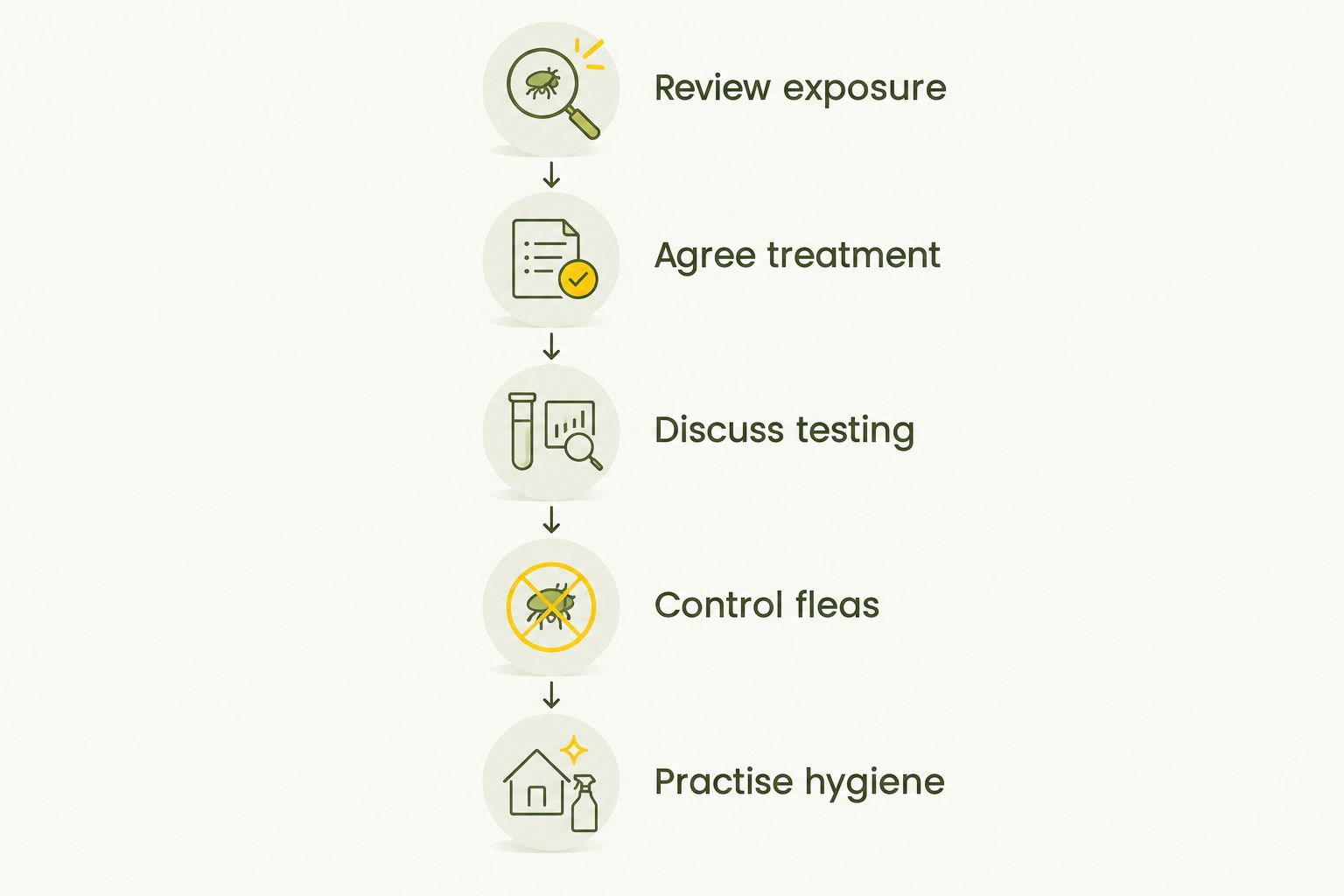
- Review exposure. Write down the main diet, treats, hunting, scavenging, flea history and travel. Bring the food label if you are unsure what the recipe contains.
- Agree treatment. Ask your vet which parasites need covering and how often your dog needs treatment. Give an accurate current weight and mention other medicines.
- Discuss testing. Ask whether faecal testing is useful for your dog and what the selected test can detect. Follow the practice's sample-collection instructions.
- Control fleas. Discuss flea prevention alongside worm control. Treating a tapeworm without addressing an ongoing flea problem leaves a route for reinfection.
- Practise hygiene. Pick up poo promptly, wash hands and clean feeding equipment. Keep children away from raw-food preparation and dog faeces.
Keep a note of the worming product and the date you gave it. That gives your vet a useful starting point for checking coverage and the right dose for your dog's current weight.
Is worming or a poo test better for a raw-fed dog?
Worming and faecal testing serve different purposes; neither is a universal replacement for the other. A suitable medicine treats the parasites within its licensed scope, while a test looks for evidence included in that test's scope.
| Approach | Best for | Main benefit | Main limitation |
|---|---|---|---|
| Veterinary worming plan | Dogs needing treatment matched to their exposure | Targets specified parasites with an appropriate medicine | Products differ in coverage; treatment does not stop future exposure |
| Faecal testing | Investigating suspected intestinal parasites or supporting a monitoring plan | Provides evidence to inform veterinary decisions | A negative result does not exclude every parasite or every infection |
| Exposure reduction | Every household alongside veterinary care | Reduces avoidable contact with infectious material | Cannot diagnose infection or clear an established worm burden |
A poo test can be a useful part of care when your vet recommends it. Ask what the result tells you and whether it changes the next step: a negative result does not exclude every parasite or infection.
For your 2026 review, request a clear record of the medicine, parasites covered and next action. That is more useful than a reminder labelled only worming, especially when several people care for the same dog.
What signs of worms should you look for?
Possible signs include visible worms or segments, diarrhoea, vomiting, weight loss and a swollen-looking abdomen in puppies. Some infected dogs show no obvious signs, and these symptoms also occur with conditions unrelated to worms.
Rice-like pieces around the bottom or in bedding can be tapeworm segments. Scooting alone does not diagnose worms; anal-gland problems and irritation are other explanations that need assessment.
If you find something suspicious, take a clear photograph and ask your practice whether to bring a sample. Note appetite, stools, weight changes and the latest parasite treatment, rather than trying several remedies before seeking advice.
Contact your vet promptly if your dog is unwell. Repeated vomiting, blood in the stool, marked weakness or a painful, swollen abdomen need urgent veterinary assessment, particularly in puppies. Do not wait for a routine worm test when your dog is deteriorating.
Does a healthy-looking dog still need routine parasite care?
Yes, routine parasite care matters even when your dog seems well, whatever their diet. Some infections have no obvious signs, so appearance alone cannot confirm whether a dog has worms. Keep to the plan agreed with your vet and mention changes such as hunting or travel.
Do furry rabbit ears or garlic replace worming?
No, furry rabbit ears and garlic are not substitutes for veterinary parasite control. There is no established basis for treating a furry chew as a reliable way to remove intestinal worms, and garlic can be toxic to dogs.
Treats belong in a feeding discussion, not a treatment plan. Avoid giving concentrated supplements or home remedies to a dog with suspected worms, particularly before your vet has assessed the problem.
Do you need to stop raw feeding if your dog has worms?
A worm diagnosis does not, by itself, establish that raw food caused the infection or that you must stop feeding it. The next step is appropriate treatment and a review of possible sources with your vet, including diet, fleas and scavenging. Your vet can advise whether any feeding changes are needed for your individual dog.
Raw Direct's raw dog food range offers feeding choices; parasite treatment is a separate part of your dog's care. If a particular food is being investigated, keep the packaging and follow the advice from your vet and supplier.
FAQ
Can raw fed dogs get worms even if their food is commercially made?
Yes, raw-fed dogs can get worms even when they eat commercially made food. Exposure also comes from infected fleas, prey and contaminated surroundings, so commercial sourcing does not replace a veterinary parasite plan.
Does freezing raw dog food make it worm-free?
Freezing can control certain parasites under suitable temperature and time conditions, but it does not guarantee food is free of every parasite. Ask your supplier about processing and follow its handling instructions alongside your vet's parasite advice.
How often should I worm my raw-fed dog in 2026?
Your raw-fed dog's worming schedule in 2026 should follow a veterinary assessment of diet, age, hunting, flea exposure and travel. There is no single schedule suitable for every raw-fed dog.
Can my dog have worms if I cannot see any in the poo?
Yes, your dog can have worms without visible worms in the poo. Many parasite eggs are microscopic, and the absence of visible worms does not rule out infection.
Will changing from raw food to kibble get rid of worms?
Changing from raw food to kibble does not treat an existing worm infection. Your dog needs an appropriate veterinary treatment plan, and exposures such as fleas and hunting still need attention.
Can people catch worms from a raw-fed dog?
People can acquire certain parasites associated with dogs, regardless of what the dog eats. Prompt poo collection, handwashing and appropriate veterinary parasite control help reduce household exposure.
Is a negative worm test enough to stop worming?
A negative worm test can help your vet plan care, but it does not exclude every parasite or infection. Ask what the test covered and whether the result changes your dog's treatment or testing schedule.
One last thing
Keep food choices and parasite care connected, without treating them as the same decision. Choosing meals thoughtfully, following handling instructions and keeping routine veterinary care up to date are practical steps you can take together.
When planning your next Raw Direct order, keep your dog's care reminders in the same place as their feeding notes. At your next veterinary review, check that the parasite plan still suits their current diet and habits.