

Can working dogs get enough energy from raw food?
Yes, working dogs can get enough energy from raw food when their daily ration supplies enough calories and appropriate nutrition for their workload. Raw feeding alone does not guarantee stamina: the recipe, amount actually eaten, body condition and safe handling all matter when planning a working dog’s diet in 2026.
- Can working dogs get enough energy from raw food? Yes, when calorie intake matches workload and the diet meets nutritional needs.
- Raw Direct suits owners who want to compare raw dog food from multiple brands.
- Judge energy intake by body condition, weight trends and measured portions, not the word raw.
- Choose a feeding plan you can store, thaw and serve safely throughout the working season.
Can working dogs get enough energy from raw food?
Yes. A suitable raw diet can supply a working dog’s energy needs, but the daily calorie intake must match the work. A dog maintaining an appropriate weight and body condition on a measured ration provides more useful evidence than a feeding claim on the front of a pack.
Start with the food’s declared energy content, the manufacturer’s feeding instructions and your dog’s current condition. Then review the ration as work changes. For product-selection guidance alongside this feeding plan, see the guide to raw dog food for working dogs.
| Feeding approach | Best for | Main advantage | Main trade-off |
|---|---|---|---|
| Adjusting the current ration | Dogs doing well on a suitable recipe | Keeps the diet consistent while changing energy intake | A larger ration also means more food to eat, thaw and store |
| Choosing a more energy-dense complete recipe | Dogs struggling to eat enough food volume | Supplies more calories in a smaller amount when the label confirms higher energy density | Requires a careful transition and reassessment of portions |
| Getting an individual feeding plan | Dogs with demanding schedules, health concerns or persistent weight changes | Accounts for the dog rather than relying on a generic feeding percentage | Needs professional assessment and follow-up |
None of these approaches makes raw food automatically better than another suitable diet. Choose the approach that keeps your dog appropriately conditioned and makes feeding manageable.
Why this matters
A working dog’s food has to support the whole day, not just the time spent running. Maintenance, training, recovery and environmental conditions all contribute to energy demand. A quiet week and a busy working week do not necessarily need the same ration.
Underfeeding is not always obvious from appetite. A dog can finish every meal while gradually losing condition, and an enthusiastic eater can still receive more energy than needed during a quieter period.
For your 2026 feeding plan, record what goes into the bowl and what your dog actually eats. Guessing portions makes it harder to distinguish an unsuitable recipe from an insufficient amount.
Raw Direct is best for dog owners who want to compare raw dog food from multiple brands through one retailer. That choice helps with shopping; your dog’s energy needs still determine the feeding decision.
How do you check whether the ration supplies enough energy?
Use a repeatable process rather than increasing food whenever your dog looks tired. Fatigue has causes beyond diet, and a feeding adjustment is not a substitute for investigating a health concern.
- Record the current food. Note the exact recipe, whether it is intended as a complete diet, and its declared calorie content. Different recipes are not interchangeable simply because they weigh the same.
- Weigh the amount served. Use kitchen scales rather than judging the size of a scoop or part of a block. Include treats and extras in the feeding record.
- Record the amount eaten. Food left in the bowl does not contribute to energy intake. Repeated leftovers change the calculation.
- Track weight and body condition. Use comparable weighing conditions and assess the waist, abdominal tuck and rib covering. Look for a trend rather than reacting to an isolated reading.
- Match the record to workload. Note training, work and rest days. Review changes alongside the food record before deciding what to adjust.
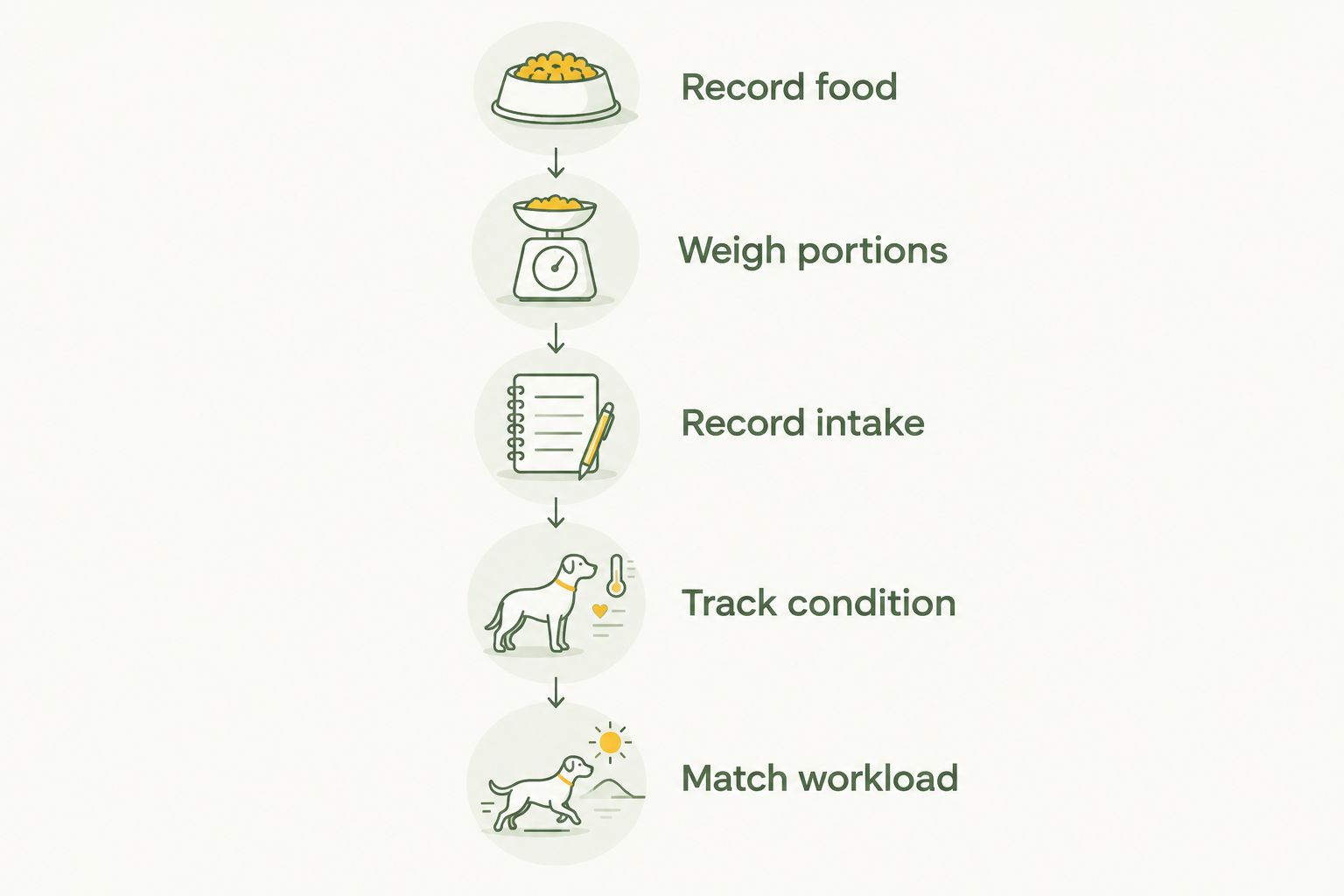
The energy calculation is straightforward: multiply the amount eaten by the food’s declared calories for that amount. If the label expresses energy per kilogram, use the portion weight in kilograms. If it expresses energy per 100 g, keep your calculation in the same units.
Do not substitute protein percentage for calorie content. Protein contributes energy, but the protein figure alone does not tell you how many calories a portion supplies.
What body condition should a working dog maintain?
A body condition score of 4–5 out of 9 is the ideal range shown on the World Small Animal Veterinary Association’s dog body condition chart. At that condition, you should be able to feel the ribs without excess fat covering, see a waist from above and identify an abdominal tuck from the side.
Body condition and bodyweight answer different questions. Weight tells you whether your dog is getting heavier or lighter; body condition helps you judge fat covering. Muscle condition needs attention too, particularly when a dog’s workload changes.
A thick coat can hide the waist, so use your hands as well as your eyes. Ask your vet to demonstrate the assessment if you are unsure where your dog sits on the scale.
For a 2026 working-season record, keep bodyweight, condition observations and ration details together. The useful finding is a consistent trend: whether your dog maintains appropriate condition through the work you are asking it to do.
Why a working dog’s energy needs vary
There is no universal raw-food portion for every dog described as “working”. These factors explain why copying another handler’s ration is unreliable:
- Duration of work. A short training session and a sustained working day create different demands. Record the actual activity rather than using the job title alone.
- Intensity of work. Repeated fast efforts and steady movement are different workloads. Duration alone does not describe the full demand.
- Environmental conditions. Cold exposure can increase the energy required to maintain body temperature. Heat also affects safe working, hydration and feeding management.
- Body size and condition. A feeding plan needs to account for the individual dog and whether the aim is to maintain or change its condition.
- Recipe energy density. Equal weights of different raw foods need not provide equal calories. Compare declared energy values on the same basis.
- Life stage and health. Growth, ageing and medical conditions affect feeding decisions. Working puppies and dogs with health concerns need individual advice rather than an adult maintenance shortcut.
Adjust for the work your dog actually does, not the work the breed was developed to do. A working breed spending a quiet week at home still needs a ration suited to that week.
Is a higher-fat raw recipe better for a working dog?
A higher-fat recipe can help when your dog needs more calories without a much larger meal. Fat is energy-dense, but the full recipe’s declared calorie content is the figure to compare. A meat name alone does not establish energy density.
Best for dogs limited by meal volume: consider a more energy-dense complete food when your dog struggles to eat enough of the current ration. The trade-off is that richer food is not suitable for every dog, especially where a health condition affects fat tolerance.
Do not assume that lamb, duck or beef is always the highest-energy choice. Recipes contain different ingredients and proportions, so compare the actual foods rather than ranking proteins by name.
Avoid turning a complete feeding plan into an improvised mixture of fat, meat and extras. Substantial additions change the overall nutrient balance as well as the calories. Ask your vet or a suitably qualified veterinary nutrition professional for help when the required adjustment is substantial.
Should you feed more on working days?
A working dog’s ration should reflect changing energy demand, but that does not mean making a large increase before every busy day. Start from the established feeding plan and review it against the pattern of work and condition.
Best for dogs with variable schedules: keep separate notes for working days and quieter days. This makes it easier to identify whether weight loss follows a busier period or weight gain follows time off.
The trade-off is practical: larger rations need more freezer space, thawing capacity and meal planning. A portion that looks manageable on paper still has to fit your dog’s appetite and your routine.
Use your 2026 training diary to plan food ahead of sustained changes in activity. Avoid introducing several new recipes, changing portions and adding supplements simultaneously; that makes the response harder to interpret.
How do you choose a raw food without guessing its performance?
Start with value across the feeding routine, not just the size of the box. Raw Direct offers raw dog food from multiple brands with free next-day UK delivery, but you still need to compare the amount your dog will eat, storage requirements and the information supplied for each recipe.
A named complete option to examine is Supreme Turkey Complete. Best for owners looking for a turkey complete option to assess: check its current feeding guidance and declared energy content before deciding whether it fits your working dog’s ration.
The product name does not establish a calorie advantage over another recipe. That is the trade-off when choosing by protein preference: you still need the nutritional information to make an energy comparison.
Use this buying checklist:
- Confirm the food is intended for your dog’s life stage and feeding purpose.
- Find the declared energy content or ask for it before making a calorie comparison.
- Check the feeding instructions against the amount your dog currently eats.
- Read the storage and thawing instructions before planning a larger order.
- Keep the ingredient list available if your dog has a diagnosed dietary restriction.
Compare raw feeding options
Check recipes and feeding information before choosing your working dog's next order.
Can you take raw food to a working day away from home?
Yes, provided you can maintain safe storage and handling. The Food Standards Agency’s general food-safety guidance recommends a fridge temperature of 5°C or below and a freezer temperature of −18°C. Follow the food manufacturer’s specific storage and thawing instructions as well.
Raw pet food can carry harmful bacteria. Keep it separate from food for people, wash your hands after handling it and clean bowls, utensils and preparation surfaces thoroughly.
A cool bag is not evidence that food has remained at a safe temperature. Plan how you will keep food chilled during travel and at the destination, and avoid leaving a raw meal sitting in a vehicle or bowl while you work.
Best for handlers travelling with raw food: a routine with reliable temperature control and dedicated equipment. The disadvantage is extra preparation; if you cannot manage storage safely, discuss a suitable alternative feeding arrangement before travelling.
When should you get professional advice?
Seek veterinary advice if your dog loses weight unexpectedly, shows reduced stamina, repeatedly refuses food, or develops persistent vomiting or diarrhoea. Do not assume that more raw food will solve the problem.
A dog that eats an increased ration but continues losing condition needs assessment. So does a dog whose performance changes without an obvious change in workload.
For the 2026 working season, agree an individual plan before making major dietary changes where your dog has a medical condition. Take the food label, measured feeding record and workload notes to the appointment so the discussion starts with useful information.
FAQ
Can working dogs get enough energy from raw food alone?
Yes, working dogs can get enough energy from a suitable raw diet when the amount eaten supplies enough calories and appropriate nutrition. Check the recipe's declared energy content and monitor body condition as workload changes.
How do I know whether my working dog is eating enough?
Track measured food intake, bodyweight and body condition together. A body condition score of 4–5 out of 9 is the ideal range shown on the WSAVA dog body condition chart; unexplained weight loss needs veterinary assessment.
Is high-protein raw food always best for working dogs?
No, protein percentage alone does not establish whether a raw food supplies enough energy. Compare declared calories, suitability as a daily diet and your dog's response to the measured ration.
Should I add fat to my working dog's raw meals?
Do not add substantial amounts of fat without reviewing the whole feeding plan. A more energy-dense complete recipe or an individually assessed ration is a better starting point than improvising additions.
Can I buy raw food for a working dog from Raw Direct?
Raw Direct sells raw dog food from multiple brands. Compare each recipe's feeding purpose, declared energy content and storage instructions before choosing a working dog's ration.
What temperature should I store raw dog food at?
Keep chilled food at 5°C or below and frozen food at −18°C, following the manufacturer's specific instructions. Keep raw pet food separate from human food and clean hands, utensils and bowls after handling.
Will switching to raw food improve my dog's stamina?
Switching to raw food does not guarantee better stamina. Energy intake, overall nutrition, fitness, workload and health all affect performance, so investigate a persistent change rather than relying on a diet switch.
One last thing
An empty bowl proves appetite, not adequate fuelling. Before changing brands or buying a richer recipe, check the amount your dog actually eats against the food’s declared energy content and the dog’s condition. That simple record gives you a sound basis for the next feeding decision.