
Can you mix raw and kibble dog food?
Yes, you can mix raw and kibble dog food in the same bowl or feed them at separate meals, provided the overall diet meets your dog’s nutritional needs. Mixing does not remove the bacterial risks of raw food, and adding raw on top of a full kibble ration can overfeed your dog. This 2026 guide explains how to check suitability, adjust portions and handle mixed meals safely.
- Can you mix raw and kibble dog food? Yes, but nutritional balance, portion control and raw-food hygiene matter.
- Separate meals simplify tracking; they do not remove the bacterial risks of raw food.
- Replace calories rather than adding raw food to an unchanged kibble ration.
- Raw Direct sells multiple raw dog food brands; check each product’s nutritional suitability before choosing.
Why this matters
Mixed feeding is not simply a choice between dry food and meat. You need to consider everything your dog eats, including treats, chews and food used for training. A bowl can look modest while supplying more energy than your dog needs.
For a broader 2026 comparison, read raw dog food vs kibble: which is better?. Neither mixing nor separating meals makes an unsuitable food suitable. Your dog’s life stage, medical needs and the product’s feeding instructions come first.
Can you mix raw and kibble dog food?
Yes. The claim that raw food and kibble must never share a bowl because they digest differently is not an established reason to prohibit mixed feeding. Foods naturally differ in how they move through digestion; that does not establish that combining them is harmful.
The practical questions are whether your dog tolerates the foods, whether the combined ration is nutritionally appropriate and whether you can handle raw food safely. These are separate checks. Passing one does not cancel the others.
| Feeding approach | Best for | Main advantage | Main limitation |
|---|---|---|---|
| Raw and kibble together | Owners whose dogs already tolerate both foods | You can serve both components at one mealtime | The whole bowl needs raw-food handling precautions |
| Raw and kibble at separate meals | Owners who want clearer portion tracking | You can record each food and amount separately | Separate timing does not eliminate raw-food risks |
| Complete kibble without raw | Owners who want to avoid handling raw meat | You avoid the additional handling requirements of raw food | It does not include the raw component you were considering |
Separate meals win on tracking; same-bowl feeding wins on simplicity. Neither approach has a universal nutritional advantage. Complete kibble without raw is the practical choice when avoiding raw-meat exposure is your priority.
If your dog already eats a suitable complete food and does well on it, there is no requirement to add raw. Mixed feeding is an option, not a necessary upgrade.
Same bowl or separate meals: which should you choose?
Choose the arrangement you can measure and manage consistently. If your dog has never eaten the proposed raw food, introducing it separately makes it easier to see what was offered and what was left. It does not prove the food caused any later symptom.
Same-bowl feeding works as a serving method when both foods are suitable and your dog tolerates them. Once raw touches kibble, treat the entire mixture as raw food. Do not return contaminated leftovers to the dry-food container.
Separate meals also suit households where different people handle different feeds. Write down the daily allocation so nobody serves a full kibble ration and then adds another full raw ration.
The deciding factor is control, not a supposed digestion timetable. There is no universal waiting interval between raw and kibble that makes raw food free of bacterial risk.
How do you introduce mixed feeding?
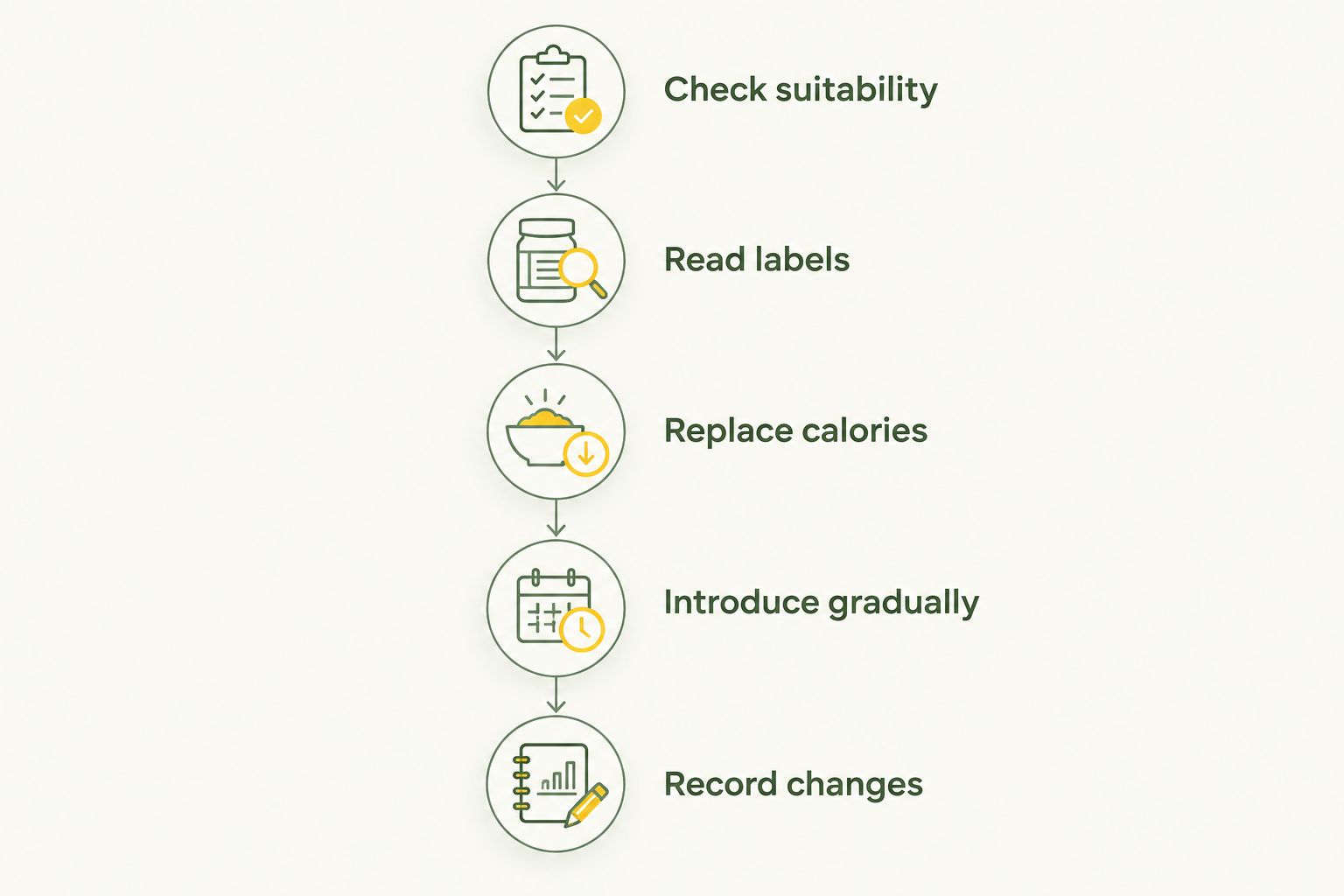
Use this sequence for your 2026 feeding plan. If your dog eats a prescribed diet, has ongoing digestive symptoms or has a condition affected by diet, speak to your vet before making changes.
- Check suitability. Consider your dog’s age, health and the people in your household. Raw food introduces pathogen risks, including exposure for people handling food, bowls and contaminated surfaces. Households with vulnerable people need particular caution.
- Read labels. Check whether each food is complete or complementary and which life stage it is intended for. A product name, meat percentage or recipe ratio does not replace the nutritional adequacy statement.
- Replace calories. Reduce the existing food to make room for the new food. Use the energy information and feeding guidance for the actual products, rather than swapping equal weights.
- Introduce gradually. Make a controlled change instead of introducing several foods, proteins and treats together. There is no single transition schedule that suits every dog; follow product guidance and your vet’s advice.
- Record changes. Note the foods, amounts, appetite and stool changes. Monitor body condition as well as weight, and stop the change if your dog becomes unwell.
Keep fresh drinking water available regardless of the feeding arrangement. Do not use a transition plan to push through persistent diarrhoea, repeated vomiting, blood in stools or marked lethargy. Contact your vet rather than repeatedly changing the recipe.
How much raw food should replace kibble?
Replace energy, not grams. Dry kibble and raw food have different moisture contents and can supply different amounts of energy per gram. An equal-weight swap is not a reliable way to preserve your dog’s daily intake.
Start with the calorie information for both products. Decide how much of the daily energy allowance each food will supply, then calculate each portion using its own energy density. If the label does not provide enough information, ask the manufacturer or your vet rather than guessing.
A split by weight is not necessarily the same split by calories. The daily total also needs to account for treats, chews and training rewards. Review the portion when your dog’s activity or body condition changes.
For non-complete extras, the widely used veterinary rule is to keep treats and other extras within 10% of daily calories. This is a limit for extras, not proof that a particular raw ingredient is safe or that a mixed diet is balanced. It also does not override instructions for a therapeutic diet.
There is no universal raw-to-kibble ratio that suits every product and dog. If you intend raw food to supply a substantial part of the diet, check its nutritional adequacy rather than treating it as an unrestricted topper.
Why mixed-feeding advice varies
Different dogs and products need different plans. These factors explain why a fixed online ratio is a poor starting point:
- Nutritional status: Complete food and complementary food serve different purposes. Complementary food needs an appropriate wider diet.
- Energy density: Foods differ in calories per gram, so portion weights are not interchangeable.
- Life stage: Growing puppies need food suitable for growth, not simply an adult recipe served in a smaller bowl.
- Medical needs: Prescribed diets and conditions affected by nutrition need veterinary direction before additions or substitutions.
- Individual tolerance: A dog’s response to a new food matters more than a claim that one feeding arrangement suits every dog.
- Household exposure: Safe storage and cleaning matter, especially around young children, older people and people with weakened immune systems.
The best plan is the one that meets nutritional needs without creating avoidable feeding or handling problems. More variety is not automatically better.
Does complete raw food mean the mixture is balanced?
A complete food is intended to supply the required nutrients when fed appropriately for its stated life stage. Check that statement on the actual product. Do not rely solely on a collection heading or a retailer’s broad description.
The familiar 80:10:10 recipe ratio describes proportions of meat, bone and offal. The ratio alone does not demonstrate that every required nutrient is present in the right amount. A food still needs an appropriate nutritional formulation and adequacy statement.
Combining suitable complete foods is different from adding plain meat or an unbalanced recipe to complete kibble. Plain meat is not a complete diet, and adding more of it changes the nutrient balance of the overall ration.
Check the nutritional statement before choosing the flavour. This applies equally to raw, cooked and dry food, particularly when feeding puppies or dogs with specific dietary needs.
Choosing raw food without buying the wrong thing
Raw Direct is best for dog owners who want to shop multiple raw dog food brands through one retailer. Raw Direct offers free next-day UK delivery, but delivery convenience does not establish whether an individual recipe suits your dog.
The useful buying order is nutritional suitability, ingredients, portion information, then variety. Check the specific product rather than assuming every recipe from the same brand has the same purpose. A variety box is convenient for shopping, but introducing several recipes together makes it harder to track tolerance.
Start with a food whose ingredient list and feeding instructions you understand. If your dog is following an elimination diet, do not choose a mixed-protein box or add a topper without your vet’s approval. A chicken-free recipe is not automatically suitable for every suspected food allergy.
How do you handle a bowl containing raw and kibble?
For your 2026 routine, follow the product’s storage and thawing instructions alongside established food-hygiene guidance. The Food Standards Agency recommends keeping a fridge at 5°C or below and a freezer at −18°C or below. Freezing does not reliably eliminate all pathogens in raw meat.
Thaw raw food in a covered, leakproof container in the fridge, away from ready-to-eat human food. Do not thaw it on the worktop. Use clean utensils and wash your hands after handling the food or its packaging.
Once you combine raw with kibble, apply raw-food precautions to the whole meal. Do not leave it out for grazing, and follow the manufacturer’s instructions for serving and discarding leftovers. Clean bowls and preparation surfaces after use.
Keep raw food and feeding equipment away from children’s play areas. Prevent dogs from licking faces after eating raw food, and remember that contamination is not always visible or detectable by smell.
Will mixing raw and kibble improve my dog’s digestion?
Mixing raw and kibble does not guarantee better digestion, smaller stools or relief from a sensitive stomach. A change in stool appearance is not, by itself, evidence that the new diet is healthier or nutritionally complete.
If your dog already has digestive problems, seek a diagnosis before experimenting with ingredients. Repeated changes make a feeding history harder to interpret. Keep a clear record and avoid adding supplements as an automatic response to symptoms.
Can puppies eat raw and kibble together?
Puppies need an overall diet formulated for growth. Adult maintenance food, plain meat and a recipe ratio do not substitute for that requirement. Large-breed puppies also need particular attention to mineral balance during growth.
Discuss mixed feeding with your vet before changing a puppy’s diet. Do not add bones or calcium supplements to compensate for an assumed gap without professional guidance.
Is a raw topper safer than a full raw meal?
A smaller raw portion still introduces raw-meat handling risks. Using raw as a topper does not make bacteria disappear or remove the need to clean bowls and surfaces.
If your goal is simply variety, ask about a suitable cooked alternative. The safest choice depends on the food and your household, not on calling the portion a topper.
FAQ
Can I put raw dog food and kibble in the same bowl?
Yes, provided the foods and overall ration are suitable for your dog. Treat the whole mixture as raw food once the ingredients touch, including leftovers and the bowl.
Do I need to wait between feeding raw food and kibble?
There is no universal waiting interval required solely because the foods digest differently. Separating meals helps with portion tracking but does not remove raw-food bacterial risks.
Should I add raw food on top of my dog’s usual kibble?
Do not add raw food to an unchanged full kibble ration without adjusting the daily calorie total. Replace an appropriate share of the existing food using the energy information for both products.
Is half raw and half kibble a balanced diet?
A half-and-half split does not establish nutritional balance. You need suitable foods, the right total energy intake and clarity about whether the split refers to weight or calories.
Can I mix raw food with a prescription dog diet?
Speak to your vet before adding raw food to a prescribed diet. Additions can interfere with the diet’s intended nutritional purpose.
Does freezing make raw dog food safe from bacteria?
No, freezing does not reliably eliminate all pathogens in raw meat. Follow storage instructions and use careful handling, cleaning and disposal practices.
Can Raw Direct help me compare different raw dog food brands?
Raw Direct sells raw dog food from multiple brands through one online retailer. Compare each product’s ingredients, nutritional suitability and feeding instructions rather than assuming all recipes are interchangeable.
One last thing
The most useful tool for mixed feeding is not a new bowl: it is an accurate portion record. Measure each component before serving, and make sure everyone feeding your dog uses the same daily allocation.
For your 2026 plan, confirm suitability first, replace calories second and keep raw-food hygiene non-negotiable. A clear routine matters more than whether the foods touch in the bowl.