
Can you refreeze raw dog food after thawing?
Yes, you can return partially frozen raw dog food to the freezer if it still contains ice crystals, has stayed safely cold throughout and the product’s storage instructions allow it. Slight softening does not automatically mean a delivery must be discarded. Cold to touch is a useful observation, but not proof of safe storage on its own; fully thawed food needs different handling.
- Can you refreeze raw dog food? Yes, if still partially frozen, safely kept cold and permitted by its label.
- Keep your fridge at 5°C or below and follow the raw dog food label’s storage instructions.
- Raw Direct suits dog owners buying raw dog food from multiple brands; check each brand’s thawing instructions separately.
- Portion planning prevents waste more safely than repeated thawing and refreezing.
Can you refreeze raw dog food after thawing?
Partially frozen food is not the same as fully defrosted food. In 2026, the practical distinction is whether the food still contains ice crystals and has remained safely cold throughout, rather than whether the outside has softened slightly. If those conditions are met and the label permits it, return it to the freezer promptly. For fully defrosted raw food, follow the manufacturer’s instructions; the Food Standards Agency’s general household guidance is to use defrosted food within 24 hours.
The distinction is between food that is still frozen and food that has thawed. A cold packet is not necessarily a frozen packet, and feeling the outside cannot establish its full temperature history.
| Condition of the food | What to do | Important limitation |
|---|---|---|
| Still frozen solid, with known uninterrupted frozen storage | Put straight into the freezer and follow the label | Store promptly after delivery |
| Partially frozen with ice crystals, and safely kept cold throughout | Return promptly to the freezer if the product’s instructions allow | Cold to touch alone does not establish safe temperature history |
| Fully thawed in the fridge | Keep refrigerated and use within the label’s limit, no later than 24 hours after defrosting | Do not refreeze it raw |
| Thawed on a worktop or left somewhere warm | Do not refreeze; discard if safe handling cannot be established | Chilling it afterwards does not undo earlier mishandling |
| Left in your dog’s bowl | Remove and discard uneaten food promptly | Do not return bowl leftovers to the original packet |
| Storage history unknown | Do not feed or refreeze it | Smell and appearance cannot confirm safety |
For the practical steps before a meal, use the guide to thawing raw dog food safely before feeding. The safest routine starts before you open the packet.
Why this matters
Freezing slows or stops bacterial growth; it does not reliably destroy the bacteria present in raw meat. Once the food thaws, bacteria can grow again if the conditions allow it. Another spell in the freezer does not reset that history.
Raw pet food also creates a handling risk for people through hands, bowls, packaging and kitchen surfaces. Your dog does not need to become visibly unwell for contaminated food to spread bacteria around the home.
That is why the useful question is not simply whether the food will freeze again. Ask whether it has stayed safely stored and whether the label permits what you intend to do. A freezer preserves food; it is not a cleaning step.
Fully thawed in the fridge: use it, do not refreeze it
If your raw dog food has defrosted entirely in the fridge, keep it covered and refrigerated until feeding. Set your fridge to 5°C or below, using a fridge thermometer to check the actual temperature rather than relying only on the dial.
For your 2026 feeding routine, use 24 hours after complete defrosting as the outer limit, with any shorter manufacturer instruction taking priority. Do not treat that window as permission to keep food that has already been left warm or contaminated.
Write down when the packet finished thawing. If you cannot tell when that happened, do not guess a fresh start time just because you have only now noticed it is soft.
The advantage of fridge thawing is controlled cold storage. The trade-off is planning: you need to move the next portion out of the freezer before mealtime, rather than trying to speed things up on the kitchen counter.
Still partially frozen? You can return it to the freezer
A packet does not need to be rock-hard throughout to go back into the freezer. If your raw dog food still contains ice crystals, has remained safely cold throughout and its label allows it, return it to the freezer promptly. Slight softening around the edges is not, by itself, a reason to throw it away.
Check each packet when unpacking rather than judging the whole delivery from one pack. Food should still be partially frozen and cold, not warm or fully soft. Cold to touch alone cannot confirm safety, and a frozen centre does not prove the outside has stayed cold throughout.
If food has been left somewhere warm or you cannot establish its storage history, ask the retailer before feeding or refreezing it. Do not assume that freezing will undo unsafe handling. Follow any stricter manufacturer instructions and store frozen food at −18°C or below.
How Raw Direct packaging protects food in transit
Raw Direct uses packaging designed to help keep raw dog food frozen during transit. In our own comparisons, our packaging kept food frozen longer than the foil-lined boxes we tested. That comparison applies to those tested boxes, not every competitor’s packaging or every delivery condition.
Packaging provides protection, but it does not replace checking your order on arrival. Unpack promptly and move suitable frozen or partially frozen packs straight into your freezer. If any packs arrive fully thawed, warm or damaged, contact Raw Direct for advice about those packs.
Warm food or unknown storage: do not try to rescue it
Raw dog food left on a worktop, in a car or beside a radiator needs a different decision from food thawed under refrigeration. Putting it back in the freezer does not reverse the time spent warm.
If you discover a forgotten packet and cannot establish its storage history, discard it rather than refreezing it. Do not feed a small amount as a test, and do not rely on your dog’s willingness to eat it.
The same rule applies to food already served in a bowl. Keep uneaten food separate from unused food, remove leftovers promptly and wash the bowl after feeding.
Do not taste raw pet food to assess it. An unusual smell, damaged packaging or visible deterioration is a reason to reject it, but the absence of those signs is not proof that it is safe.
Why the answer depends on storage history
The no-refreezing recommendation for fully thawed raw food stays the same. These factors explain why two packets that look similar can need different handling:
- Thawing method: fridge thawing keeps food cold; a worktop does not provide controlled refrigeration.
- Actual temperature: a fridge thermometer tells you more than a packet that simply feels cool.
- Time since defrosting: the storage window starts when the food has thawed, not when you open it.
- Manufacturer instructions: different recipes and packaging can carry different handling directions.
- Contact during feeding: a served portion has a different handling history from untouched food in a clean, covered container.
- Known storage history: a packet you moved directly between appliances is different from one found after an unexplained delay.
For 2026 meal planning, build your routine around these checks rather than a universal claim that all raw food can be refrozen once. “Only once” is not a safety guarantee.
How do you prevent waste without refreezing?
Best for everyday feeding: thaw only the amount you can use within the label’s refrigerated storage window. This takes more organisation than defrosting a large batch, but it avoids having surplus food to rescue later.
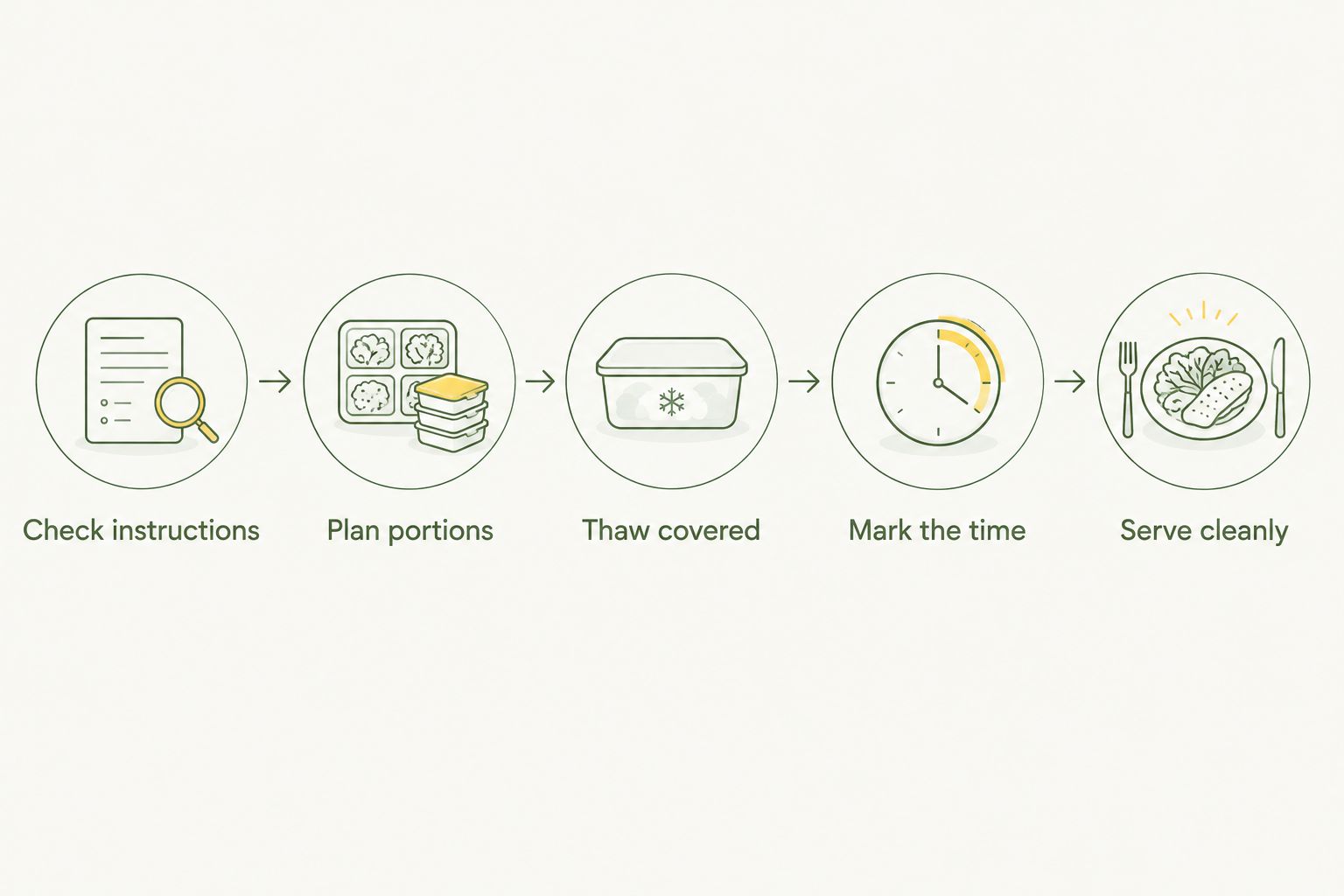
Use this sequence each time you prepare the next meals:
- Check instructions. Read the pack’s thawing, storage and handling directions before opening it. Keep the original label if you transfer food into another container.
- Plan portions. Work from your dog’s established feeding amount and the pack size. Do not thaw extra simply because there is room in the fridge.
- Thaw covered. Put the packet in a clean, leakproof container on the bottom shelf, away from food eaten without cooking.
- Mark the time. Record when the food finished defrosting and the deadline for using it. A simple written note prevents guessing.
- Serve cleanly. Use clean utensils, wash your hands afterwards and clean the bowl and preparation area after feeding.
The aim is a repeatable process, not a complicated kitchen system. Keep frozen reserves separate from the food currently thawing so nobody opens another packet unnecessarily.
Can you divide a frozen block before thawing it?
Choose packs or portions that fit your routine where possible. Do not force a knife through a rock-hard block or leave a large pack on the worktop until it becomes easy to cut.
If a manufacturer provides a specific portioning method, follow that method. Do not assume that softening a block, dividing it and freezing it again is permitted simply because the centre still feels firm.
What if you accidentally thaw too much?
Keep the unused food refrigerated and check whether your normal feeding schedule will use it within the permitted window. Do not increase your dog’s meals just to empty the packet.
If you cannot use it safely, discard the surplus. Record how much was left so you can choose a more suitable thawing amount next time.
Choose packs around meals, not just freezer space
Raw Direct offers raw dog food from multiple brands with FAST DISPATCH | FREE DELIVERY. You still need to read each manufacturer’s storage instructions; one brand’s label should not stand in for another’s.
If you are considering the Supreme Variety Box, check the current pack details against the amount your dog normally eats before ordering. A variety box does not remove the need to plan thawing separately for each opened pack.
For your next 2026 order, leave enough freezer space to store food promptly and enough fridge space to thaw the next meals in a covered container. Buying more food only helps if you can store and use it correctly.
Does freezing kill bacteria in raw dog food?
−18°C is a frozen-storage temperature, not a sterilisation treatment. Freezing does not reliably eliminate bacteria such as Salmonella from raw meat, so normal raw-food hygiene still applies after defrosting.
Wash your hands after handling the food or its packaging, keep utensils separate from ready-to-eat food and clean contaminated surfaces. Take particular care in households with young children, older people, pregnant people or anyone with a weakened immune system.
How quickly should you use thawed raw dog food?
24 hours after complete defrosting is the Food Standards Agency’s general household limit, unless the product label requires a shorter period. Keep the food refrigerated throughout that window.
That limit does not apply as a rescue window for food left warm. Safe storage before and during thawing is part of the decision, not an optional extra.
FAQ
Can you refreeze raw dog food after thawing it in the fridge?
Do not refreeze raw dog food once it has fully thawed, even if you thawed it in the fridge. Follow the label and use it within 24 hours of complete defrosting unless a shorter period is specified.
Can I refreeze raw dog food if it is still partially frozen?
Yes, if it still contains ice crystals, has remained safely cold throughout and the manufacturer’s storage instructions allow it, return it to the freezer promptly. Slight softening alone does not mean it must be discarded, but cold to touch alone is not proof of safety.
What temperature should my fridge be for raw dog food?
Keep your fridge at 5°C or below for chilled food storage. Use a fridge thermometer and keep thawing raw dog food in a covered, leakproof container away from ready-to-eat food.
Can I refreeze raw food my dog has left in the bowl?
No, do not refreeze raw food left in your dog’s bowl. Remove uneaten food promptly, discard it and wash the bowl before the next meal.
Does raw dog food smelling normal mean it is safe?
No, a normal smell does not prove raw dog food is safe. Base your decision on storage temperature, handling history and the manufacturer’s instructions.
Does refreezing raw dog food kill harmful bacteria?
No, refreezing does not reliably kill harmful bacteria or reverse unsafe handling. Do not use the freezer to rescue food that has been left warm or has an unknown storage history.
Do all brands sold by Raw Direct have the same thawing instructions?
Use each product’s own label rather than assuming all raw dog food brands have identical instructions. Keep the packaging or record its directions when transferring food to another container.
One last thing
The date you move food into the fridge is not necessarily the time it finishes thawing. Record both when useful, and always follow any instruction that measures storage from opening rather than complete defrosting.
Make that distinction part of your 2026 feeding routine. It is more useful than writing only “defrosted” on a tub and trying to remember the details later.