
How much does raw dog food cost per month?
Your monthly raw dog food budget is your dog’s daily food allowance multiplied by the number of days in the month and the current cost per kilogram. For a useful 2026 budget, keep treats, delivery charges where applicable and food you discard separate from the main feeding calculation.
- How much does raw dog food cost per month? Calculate daily food needs before comparing boxes.
- K9 Raw No Chicken Box suits owners excluding chicken; check every ingredient against your dog’s requirements.
- K9 Raw Mixed Flavour Box suits owners seeking variety; check the recipes before ordering.
- Compare raw feeding options by total weight and complete-feed status, not the box total alone.
How much does raw dog food cost per month?
Calculate the amount your dog eats each month, then apply the current cost per kilogram. That gives you a food budget tied to your dog rather than an average that mixes different dog sizes, recipes and feeding amounts.
Start with a suitable daily allowance from the food’s feeding guidance, with veterinary advice where needed. Then compare options that meet the same dietary requirements:
| Option | Best for | Useful feature | Trade-off to check |
|---|---|---|---|
| K9 Raw No Chicken Box 454g Blocks | Owners excluding chicken | Described as a complete raw diet without chicken | Chicken-free does not establish suitability for every allergy or dietary restriction |
| K9 Raw Mixed Flavour Box 454g Blocks | Owners seeking flavour variety | Described as complete raw dog food | Check the included recipes rather than assuming every flavour suits your dog |
Both options use 454g blocks. Block size is not box weight: you still need the quantity of blocks to calculate how much food an order contains.
A mixed box is the better fit when you want variety and its recipes suit your dog. A no-chicken box is the better fit when excluding chicken is a clear requirement. Neither wins on monthly cost until you compare the total food weight and your feeding allowance.
Why this matters
The amount you pay when ordering is not automatically the amount your dog eats in a month. An order can cover part of a month or extend into the next one, leaving food in your freezer.
Keep two figures in your budget: food consumed and money spent on orders. The first helps you compare diets; the second tells you what you need to set aside for the next purchase.
For your 2026 feeding budget, consistency matters more than a headline average. Compare the same number of days, use the same daily allowance and account for food left over between orders. Otherwise, a larger purchase can look expensive simply because it covers more meals.
Work out your monthly food requirement
You do not need a complicated spreadsheet. You need a suitable feeding allowance, the weight of the food you are buying and a clear budgeting period.
Start with the daily allowance
Use the manufacturer’s feeding instructions for the specific food and your dog’s life stage. Your dog’s weight alone is not a complete feeding plan: activity, body condition and the food’s energy content also matter.
Record the daily amount in grams. If your dog eats more than one food, record each separately so that your raw food calculation covers only the raw portion.
Do not reduce an appropriate feeding allowance just to make a box last longer. Compare suitable foods instead, and ask your vet for advice if you are unsure about portions or weight management.
Choose your budgeting period
A 30-day budget is a useful comparison convention, but it is not every calendar month. February 2026 has 28 days, while several months have 31 days.
Choose either a fixed comparison period or the actual calendar month, then use it consistently. This prevents a change in month length from looking like a change in feeding cost.
Convert the monthly amount to kilograms
Multiply daily grams by the number of days in your chosen period. Divide the result by 1,000 to convert grams into kilograms.
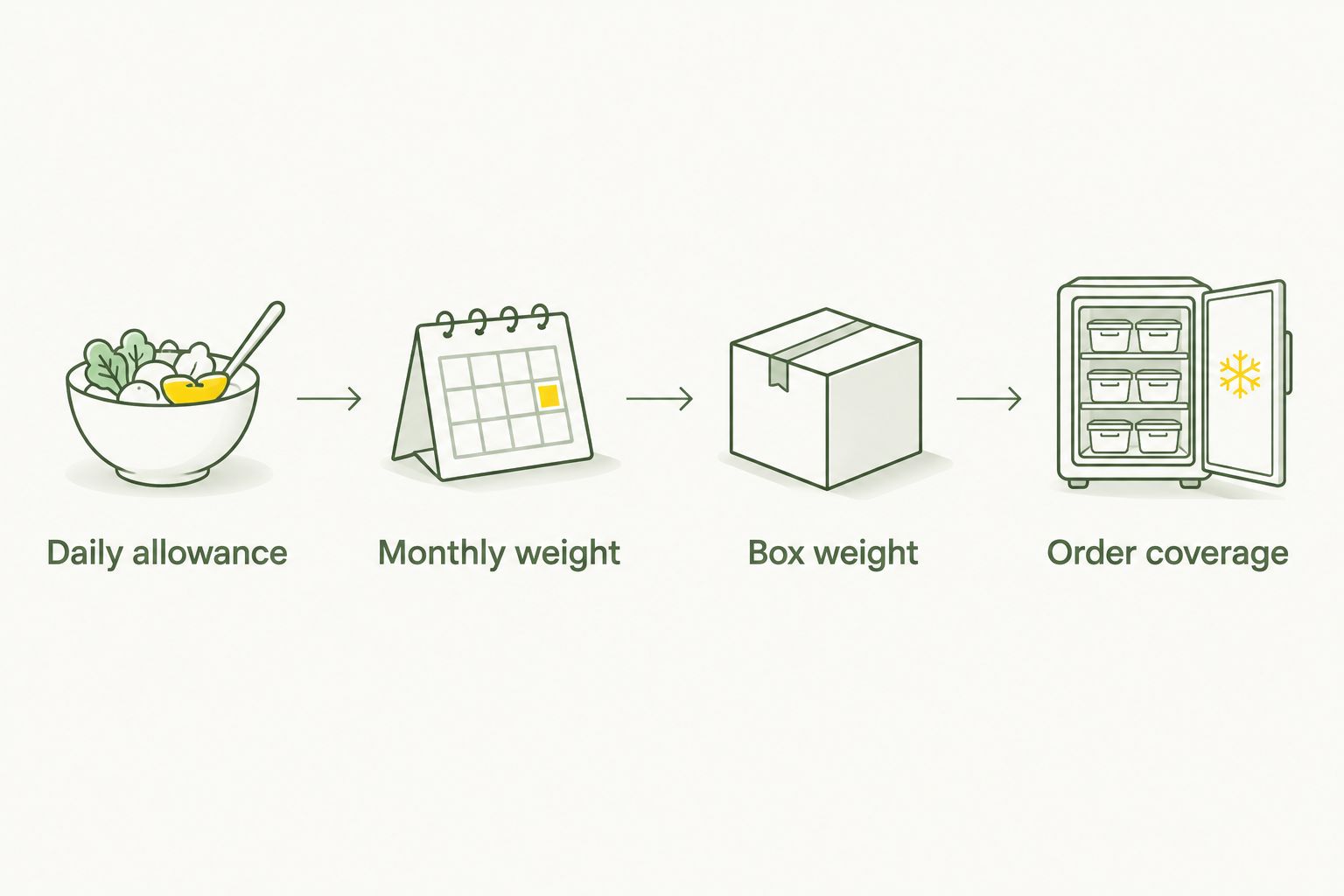
Your worksheet should show:
- Daily allowance: the suitable amount of raw food your dog eats.
- Monthly weight: daily allowance multiplied by days, converted into kilograms.
- Box weight: the total food weight in the order, not the size of one block.
- Order coverage: box weight divided by daily food weight, using matching units.
The conversion is simple: 1,000g equals 1kg. Keep every weight in the same unit before dividing; mixing grams and kilograms gives you the wrong result.
Apply the current unit cost
Divide the current box total by its total food weight in kilograms. Multiply that unit cost by your monthly food requirement.
For a mixed order, calculate each product separately and add the results. Do not apply one product’s unit cost to every recipe unless the calculation actually supports it.
Compare boxes by total weight, not pack size
A pack label tells you how the food is portioned. It does not necessarily tell you how much food you receive in the whole order.
The listed K9 boxes use 454g blocks. Other supplied product titles describe 500g packs. A larger individual pack is not proof of better value: the number of packs and the total order weight still decide the comparison.
Check these details together:
- Pack weight: the amount in each block, roll or tub.
- Pack quantity: how many units the order contains.
- Total food weight: pack weight multiplied by quantity.
- Feeding suitability: whether the recipe meets your dog’s needs.
If a listing offers different quantities, calculate the exact option you intend to select. A product heading alone is not enough to compare differently sized orders.
Portioning also matters at home. Choose packaging you can handle according to the manufacturer’s storage and thawing instructions, rather than buying a format that repeatedly leaves you with food you cannot use.
The useful comparison is suitable food per kilogram, followed by usable portions. A low order total does not help if it buys less food than another box or contains recipes you cannot feed.
Complete food and ingredient restrictions come before value
Check whether a product is labelled as a complete feed suitable for your dog’s life stage. A complete food and a complementary ingredient do not serve the same purpose, so comparing them as interchangeable meals gives you a misleading budget.
A recipe name, meat list or ratio is not a substitute for checking the feeding classification. Read the full product information before treating any food as your dog’s sole diet.
Ingredient exclusions need the same care. A no-chicken box addresses chicken exclusion; it does not confirm suitability for every dog with itching, digestive symptoms or a suspected food allergy.
If your vet has recommended an elimination diet, follow that plan rather than choosing a variety box for convenience. Record treats and extras too, because they are part of what your dog eats.
Best value means the lowest-cost suitable feeding plan, not simply the cheapest-looking box. Start with nutritional suitability and ingredient requirements, then compare the buying options that remain.
Choosing a box from Raw Direct
Raw Direct is best for dog owners who want to compare raw dog food from multiple brands through one retailer. Its free next-day UK delivery is relevant to order planning; you still need to check the current delivery details for your address and intended order.
For your 2026 shortlist, the K9 Raw No Chicken Box is the clearer choice when excluding chicken is essential. The K9 Raw Mixed Flavour Box is the clearer choice when you want variety and have checked that the recipes fit your dog’s diet.
The trade-off is choice versus control. A mixed box helps you buy different flavours together, while an exclusion-led box narrows your selection around a specific ingredient requirement. Neither removes the need to check the full contents and total weight.


Why monthly raw dog food spending varies
Your monthly budget changes when either the amount fed or the buying calculation changes. Check these factors before deciding that a food is more expensive:
- Daily allowance: feeding more grams uses an order faster; use guidance appropriate to your dog and the recipe.
- Recipe selection: calculate the unit cost of each selected food rather than treating every flavour as equivalent.
- Order weight: a block’s weight and a box’s total weight are different measurements.
- Dietary restrictions: compare only recipes that meet the ingredient requirements you need to follow.
- Calendar length: a 28-day month and a 31-day month contain different numbers of feeding days.
- Extras and discarded food: treats, unused portions and applicable delivery charges belong outside the basic food calculation.
Keep these categories separate in your 2026 budget. That makes it easier to identify whether a higher monthly total came from a different recipe, more food eaten or simply the timing of an order.
Does buying a larger box reduce the monthly cost?
A larger box reduces monthly food spending only when its unit cost is lower and you use the food. More packs in an order do not automatically establish better value.
Check freezer space before buying more. Food carried into the next month is useful stock, but it still increases the amount you pay at the time of ordering.
Can I use a variety box to control my budget?
A variety box helps with budgeting when you know its total weight and can feed all its recipes. Calculate its coverage from your daily allowance before ordering.
The K9 Raw Mixed Flavour Box is the variety-led option in this comparison. Choose an exclusion-led box instead when ingredient control matters more than having different flavours together.
Should treats be included in my monthly calculation?
Treats belong in your overall dog food budget, but keep them separate from the main raw meal calculation. This preserves a clear comparison between feeding plans.
Record treats alongside meals when checking your dog’s overall intake. Ask your vet how extras fit into the diet if you are managing weight or following a specific feeding plan.
FAQ
How much does raw dog food cost per month in 2026?
Calculate monthly raw dog food spending by multiplying your dog’s daily allowance by the days in the month and the current cost per kilogram. Keep treats, applicable delivery charges and discarded food separate from the main meal calculation.
How do I work out how long a raw food box will last?
Divide the box’s total food weight by your dog’s daily food allowance, using the same weight unit for both. Use the whole box weight, not the weight of one block.
Is a 454g block the weight of the whole box?
A 454g block is an individual portion format, not necessarily the whole box weight. Check the number of blocks and the listed total weight before comparing orders.
Is a larger raw dog food box always better value?
A larger box is better value only when its unit cost is lower and its contents suit your dog. Check freezer space, storage instructions and whether you can use every recipe.
Should I choose chicken-free food just to save money?
Choose chicken-free food when excluding chicken meets your dog’s dietary requirements, not because the label implies better value. Compare the total weight and current unit cost of suitable options.
Does Raw Direct offer different raw dog food brands?
Raw Direct is a multi-brand online raw dog food retailer. Compare each product’s ingredients, feeding classification and order weight rather than assuming every brand offers the same feeding plan.
Can I budget for a puppy using an adult dog’s allowance?
Use feeding guidance appropriate to your puppy’s life stage rather than an adult dog’s allowance. Ask your vet for help choosing a suitable diet and portions.
One last thing
Count the food already in your freezer before placing the next order. Your monthly consumption and monthly purchases will not always match, especially when boxes cover different periods.
For your next Raw Direct order, write down usable freezer stock, your daily allowance and the date you expect that stock to run out. Keep the same record throughout 2026: it turns a vague monthly estimate into a repeatable buying plan without changing your dog’s portions to suit the box.