
Is freeze-dried raw dog food as good as frozen?
Freeze-dried raw dog food can be a suitable alternative to frozen raw when both are complete foods for your dog’s life stage, but the format alone does not establish equal nutritional quality. Freeze-dried wins for storage and travel; frozen suits a home feeding routine with reliable freezer space. Neither freezing nor freeze-drying guarantees that raw food is free from harmful bacteria, so nutritional suitability and safe handling matter more than the preservation method.
- Is freeze-dried raw dog food as good as frozen? Nutritional suitability depends on the recipe, not just the format.
- Freeze-dried raw dog food is best for travel and limited freezer space; follow its storage and rehydration instructions.
- Frozen raw dog food suits home feeding, but requires freezer storage, planned thawing and careful handling.
- Raw Direct suits dog owners comparing raw dog food from multiple brands; check each recipe’s feeding designation.
Is freeze-dried raw dog food as good as frozen?
A complete freeze-dried recipe can meet your dog’s nutritional needs, just as a complete frozen recipe can. That does not mean every product in either category is interchangeable. A complementary topper is not equivalent to a complete daily meal, regardless of how it is preserved.
Start with the label. The guide to complete raw dog food covers the distinction you need before comparing formats.
| What you are comparing | Freeze-dried raw dog food | Frozen raw dog food |
|---|---|---|
| Best for | Travel and homes with limited freezer space | Home feeding with dependable freezer storage |
| Nutritional suitability | Depends on the recipe, completeness and life-stage suitability | Depends on the recipe, completeness and life-stage suitability |
| Storage before opening | Follow the pack’s dry-storage instructions | Keep frozen according to the pack instructions |
| Meal preparation | Follow instructions for serving dry or rehydrating | Thaw and serve according to the pack instructions |
| Moisture | Water has been removed during processing | Water remains in the food |
| Main advantage | No frozen storage requirement before opening when labelled for ambient storage | Moisture remains in the meal without rehydration |
| Main trade-off | Serving weight differs from wet food; rehydration adds preparation | Needs freezer space and advance thawing |
| Raw-food safety | Do not assume drying makes the food sterile | Do not assume freezing makes the food sterile |
For your 2026 buying decision, compare the actual feeding instructions and nutritional designation. A familiar protein name or an attractive ingredient list is not enough to establish that two foods provide equivalent nutrition.
Why this matters
You are choosing both a diet and a daily routine. Food that suits your dog nutritionally still needs to fit your storage, preparation and household hygiene arrangements.
The wrong comparison starts with convenience and stops there. The better comparison checks whether the food is suitable as a main meal, then asks whether you can prepare and store it correctly every day.
There is also a safety decision. Raw pet food can carry harmful bacteria, including Salmonella, and handling it can expose people as well as dogs. Dry-looking pieces still need the handling precautions on their packaging.
If your household includes young children, older people, pregnant people or someone with a weakened immune system, discuss raw feeding with your vet before choosing either format. Convenient storage is not the same as lower infection risk.
Freeze-dried raw: best for travel and limited freezer space
Freeze-dried raw removes water from frozen ingredients through a drying process. That changes storage requirements and serving weight; it does not turn an incomplete recipe into a balanced daily diet.
Its practical advantage is portability. A product labelled for ambient storage avoids the need to keep an unopened pack frozen, making it easier to plan meals away from home. Check the instructions after opening, because packaging, moisture exposure and storage conditions still matter.
Some products instruct you to add water before serving. Others permit dry feeding. Follow the specific label rather than treating every freeze-dried food as a ready-to-serve biscuit.
The trade-off is that you must pay attention to portioning and preparation. A small dry serving can represent more food than its appearance suggests, and adding water creates a meal that needs appropriate handling rather than indefinite storage in the bowl.
Choose freeze-dried for portability, provided the recipe is complete and you can follow its preparation instructions. Do not choose it on the assumption that it is automatically safer or nutritionally better than frozen raw.
Frozen raw: best for a planned home feeding routine
Frozen raw keeps the food’s moisture in the meal. For owners who already have freezer space and a reliable thawing routine, that removes the rehydration step associated with some freeze-dried products.
The main advantage is straightforward preparation once the food has thawed as directed. You can work from the manufacturer’s feeding guide, weigh the portion and serve it without estimating how much water a dry product needs.
The trade-off is storage discipline. You need room for the delivery, a way to keep it frozen, and enough time to thaw meals in the fridge. A frozen pack is not a convenient last-minute dinner if the instructions require it to be thawed first.
For a 2026 home routine, the Food Standards Agency’s general storage guidance provides useful reference points: keep your fridge at 5°C or below and your freezer at around −18°C. Those temperatures do not replace a product’s instructions or remove the risks associated with raw food.
Choose frozen for home feeding when freezer capacity and safe thawing are already part of your routine. If those arrangements are unreliable, fix them before placing a large order.
Why nutritional quality varies
The preservation method tells you how a food is processed, not everything about its suitability. These factors explain why one freeze-dried or frozen recipe can be a better fit than another:
- Complete or complementary: A complete food is intended to supply the nutrients required when fed as directed. Complementary food needs other food alongside it.
- Life-stage suitability: Check whether the food is intended for adult maintenance, growth or another stated use. An adult recipe is not automatically suitable for a puppy.
- Ingredients and recipe: Look at the full ingredient list, not just the meat named on the front. Format does not remove an ingredient your dog needs to avoid.
- Energy content: Feeding amounts depend on the food’s energy density as well as your dog’s needs. Equal weights do not necessarily provide equal energy.
- Moisture and preparation: Water removal changes the concentration shown by some label figures. Compare foods on a consistent basis.
- Manufacturing and handling: Safety controls, packaging integrity and correct storage matter in both formats. Preservation alone is not proof of pathogen control.
A recipe ratio is not a substitute for nutritional assessment. Meat, bone and organ proportions describe ingredients, but do not by themselves demonstrate that all essential nutrients are present in suitable amounts.
When comparing labels in 2026, ask the manufacturer to clarify any unclear completeness or life-stage statement. Do not infer nutritional adequacy from the word raw.
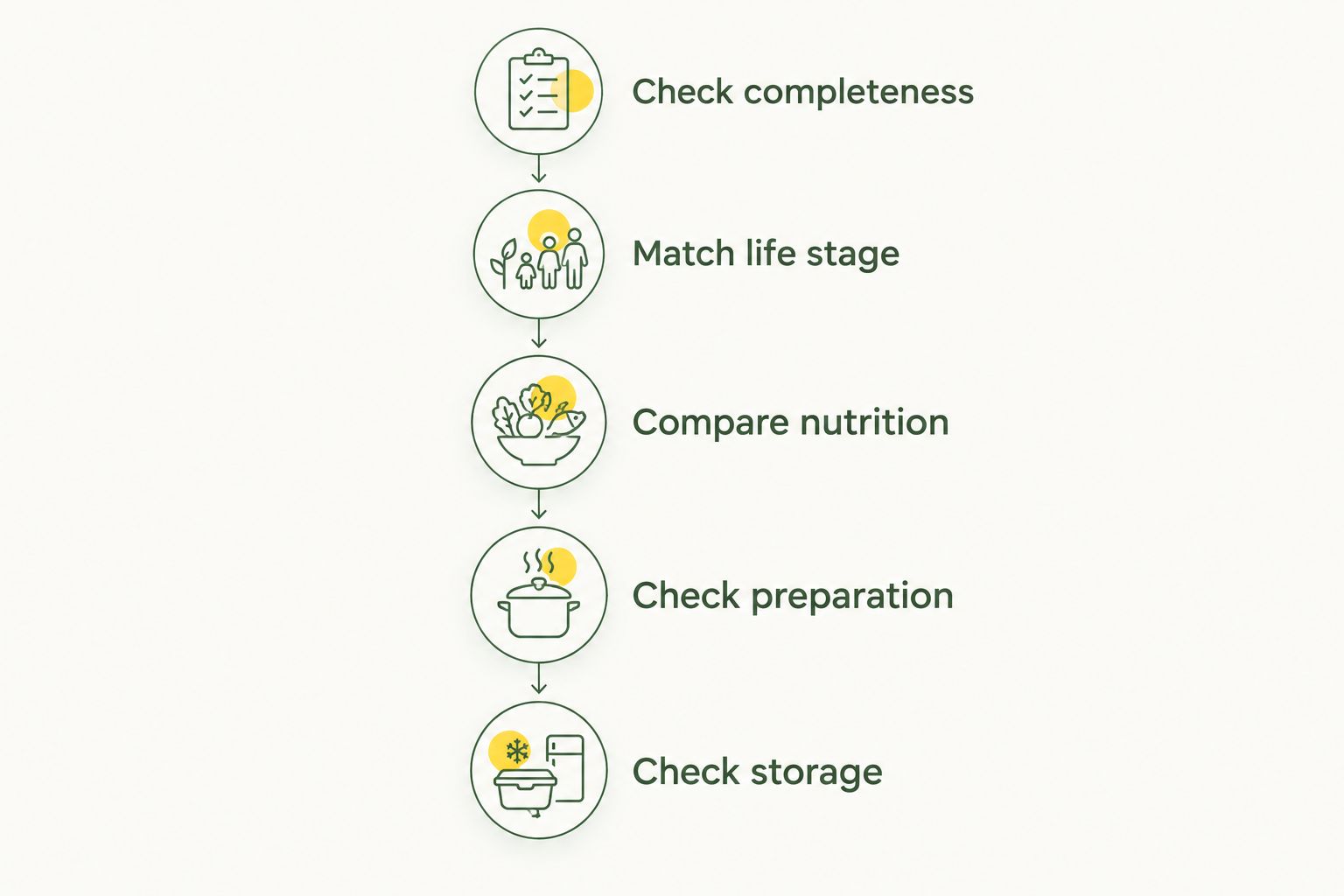
How do you compare two labels fairly?
Use the same sequence for each food. It keeps you from choosing a convenient format first and discovering later that the product is only intended as a topper.
- Check completeness. Find the complete or complementary designation. If the food will provide your dog’s main meals, confirm that it is suitable for that role.
- Match life stage. Read the intended use and feeding guidance. Puppies and dogs with medical dietary requirements need particular care when selecting a recipe.
- Compare nutrition. Review energy information and analytical constituents on a consistent basis. Ask the manufacturer for a dry-matter comparison if moisture differences make the figures hard to interpret.
- Check preparation. Establish whether the food needs thawing, rehydrating or another preparation step. Use that product’s directions, not instructions borrowed from another pack.
- Check storage. Read unopened, opened and prepared-food instructions separately. Make sure your kitchen and travel plans can meet them.
Keep each food’s feeding guide alongside it when you compare. A useful decision records both nutritional suitability and the work required to serve it correctly; neither should disappear behind a single headline ingredient.
Is freeze-dried raw dog food more nutritious than frozen?
Freeze-dried raw is not automatically more nutritious than frozen raw. Higher-looking protein figures on a dry product can reflect lower moisture rather than a better recipe.
Compare nutritional information on the same basis and check the completeness statement. Neither a drying process nor a freezing process proves that one finished recipe is nutritionally better than another.
Is freeze-dried raw dog food safer than frozen?
Freeze-dried raw is not automatically safer than frozen raw. Neither method guarantees the elimination of harmful bacteria, and the handling instructions still apply.
Ask about the manufacturer’s safety controls rather than relying on the food’s appearance. Where raw feeding presents a household concern, discuss alternatives with your vet instead of assuming that a dry format solves the problem.
Can you swap frozen raw for the same weight of freeze-dried?
Do not replace frozen raw with the same weight of freeze-dried food unless the feeding instructions explicitly support it. Removing water changes the relationship between serving weight and the amount of food supplied.
Use the new product’s feeding guide and energy information. Weigh its portion separately, and add water only in the amount directed by the manufacturer.
Make the feeding routine safe and repeatable
Safe handling belongs in the comparison from the start. In 2026, choose the format you can store and prepare correctly on ordinary busy days, not just when you have extra time.
For frozen food, thaw in the fridge according to the label rather than leaving the pack on a worktop. Keep raw food and its juices away from food prepared for people, and use clean utensils and bowls.
For freeze-dried food, protect the opened pack from moisture and follow its closure instructions. Once rehydrated, follow the prepared-food storage directions rather than treating it as a shelf-stable dry product.
Wash your hands after handling either format. NHS handwashing guidance recommends washing for at least 20 seconds; cleaning hands does not replace cleaning contaminated bowls, utensils and surfaces.
Do not invent a universal fridge-life rule for every recipe. The pack’s instructions govern opened and prepared food, and any uncertainty about storage conditions needs resolving before you serve it.
Where Raw Direct fits into the decision
For dog owners comparing raw dog food from several brands, Raw Direct offers a multi-brand catalogue and free next-day UK delivery. Raw Direct is best for dog owners who want to compare raw dog food brands through one retailer.
The benefit is a single place to compare recipes; the limitation is that you still need to check each product individually. Retailer choice does not establish that every recipe suits the same dog or serves the same feeding purpose.
For a 2026 purchase, start with nutritional suitability and compare value using the feeding amount your dog needs. Delivery convenience helps organise your routine, but it does not replace checking ingredients, completeness and storage requirements.
FAQ
Is freeze-dried raw dog food as good as frozen for everyday feeding?
Freeze-dried raw can be suitable for everyday feeding when it is complete for your dog’s life stage and fed as directed. Frozen food needs the same checks; format alone does not establish nutritional equivalence.
What’s better for travelling with my dog, freeze-dried or frozen raw?
Freeze-dried raw is the more practical option when its label permits ambient storage and you cannot maintain frozen storage. Check whether you need water for preparation and how the opened pack must be stored.
Does freeze-dried raw dog food need water added?
Add water when the product’s instructions require it. Do not use another brand’s rehydration directions or assume that every freeze-dried food should be served dry.
Can I feed my dog only freeze-dried raw food?
A complete freeze-dried food can provide your dog’s main diet when it is suitable for their life stage and fed as directed. A complementary food or topper cannot replace a complete diet on its own.
Does freezing raw dog food kill all bacteria?
Freezing does not reliably kill all harmful bacteria in raw dog food. Keep following safe storage, thawing and hygiene instructions even when the food has been frozen.
Can puppies eat freeze-dried raw dog food?
Puppies need food suitable for growth, so an adult-maintenance freeze-dried recipe is not automatically appropriate. Ask your vet about nutritional suitability and raw-feeding risks before choosing a puppy’s diet.
How can I compare the value of freeze-dried and frozen raw food?
Compare the amount needed to feed your dog according to each product’s feeding guide, not pack weight alone. Water removal changes serving weight, so equally sized packs are not necessarily equivalent.
One last thing
A smaller-looking meal does not necessarily contain less food. Freeze-drying removes water, so the visual size of a serving is a poor guide to whether you have fed enough.
Before switching formats, photograph the feeding instructions and keep them with your measuring equipment. Follow the new guide rather than recreating the size of your dog’s previous meal by eye.