
Puppy raw food calculator to a full weaning plan: 2026 workflow
Instead of manually recalculating every puppy meal, turn your puppy raw food calculator result into a feeding record that connects approved portions, milk feeds, meal times and weight checks. This 2026 workflow shows you how to build that plan without treating a calculator as a substitute for puppy-specific nutritional advice.
- A puppy raw food calculator estimates portions; it does not establish whether a recipe supports healthy growth.
- Build your weaning plan around food confirmed suitable for puppies and instructions agreed with your vet.
- Record milk feeds, food offered, food eaten and weight changes before adjusting the plan.
- Raw Direct is best for comparing raw dog food brands, not formulating puppy diets.
Why this matters
A correct weight calculation cannot make an unsuitable food suitable for a puppy. Growing dogs need an appropriate balance of nutrients, not simply enough grams of meat. Large-breed puppies need particular care with growth nutrition.
Raw Direct sells raw dog food from multiple brands. That gives you a choice of recipes, but choosing between brands comes after confirming that the specific food supports your puppy's growth stage.
Weaning also means something specific: moving from milk towards solid food. Switching an already-weaned puppy from its existing food to raw is a different workflow. Keep those plans separate so you do not accidentally remove milk feeds or change an established diet too quickly.
Raw food carries bacterial risks for dogs and people handling it. Discuss that risk with your vet before choosing it, particularly where young children, pregnant people or people with weakened immune systems share the home.
Before you start
- Gather the right records: your puppy's current weight, age, breed or expected adult size, existing feeding routine and the exact food label. For a litter, keep a separate record for every puppy.
- Confirm the feeding instructions: ask your vet to confirm the weaning approach and check the manufacturer's growth-suitability statement and puppy feeding guidance. A recipe described as complete for adult dogs is not automatically complete for growth.
- Prepare the practical kit: use a suitable weighing scale, kitchen scales, separate food containers and a spreadsheet or notebook. The hidden gotcha is calculator input: current weight and expected adult weight are different, and entering the wrong one changes the result.
Start a dated 2026 record rather than relying on an old screenshot. If the food's growth suitability or feeding instructions are unclear, resolve that before calculating portions.
Choose your planning method
Use the method that matches the question you need answered. The feeding record is the main tool during weaning; the calculator supports it.
| Method | Best for | Main advantage | Main limitation |
|---|---|---|---|
| Manufacturer's puppy feeding guide | Setting a starting portion for that exact recipe | Connects the amount to the food being fed | Still needs checking against the individual puppy's growth and condition |
| Puppy raw food calculator | Converting verified inputs into a daily estimate | Removes repeated arithmetic | Cannot assess nutritional suitability, illness or milk intake |
| Individual feeding record | Managing weaning and tracking what happens | Shows food offered, food eaten and changes over time | Requires consistent entries and review |
Do not average conflicting calculator results. Check which weight, age category, recipe and feeding method each uses, then resolve the difference with the manufacturer or your vet.
Food suitability and feeding instructions
This configuration unit establishes what you will feed and which instructions control the plan. It comes before the calculator, not afterwards.
- Read the exact recipe label. Look for a statement covering puppies, growth or an appropriate life stage; do not infer suitability from the brand name.
- Check whether the food is described as complete or complementary. Complementary food is not a complete diet by itself.
- Find the manufacturer's puppy feeding instructions. Establish whether they use current body weight, expected adult weight, age, energy needs or another method.
- Ask your vet how those instructions fit the puppy's weaning stage, including any milk feeds that remain necessary.
- Create fields named Food, Growth suitability, Feeding source and Review date in your record. These are template headings you create, not buttons on a retailer's website.
Expected result: you can identify the exact food, explain why it is suitable for growth and name the source of the feeding instructions.
An ingredient ratio such as meat, bone and offal proportions does not independently prove nutritional adequacy. Likewise, a product title containing the word complete does not tell you which life stage the formulation covers.
Do not add calcium, bone powder or other supplements to a complete puppy diet without professional advice. More is not automatically better, and adding nutrients changes the balance of the recipe.
Calculator inputs and daily portions for 2026
A useful puppy raw food calculator starts with verified inputs. You do not need a complicated spreadsheet, but you do need to understand what its result represents.
- Add Weight date, Current weight kg, Age, Expected adult size and Daily allowance g to your record. Enter expected adult weight only where the chosen feeding method requires it.
- Weigh the puppy and record the actual reading. Do not substitute an estimated weight from its breed or a previous appointment.
- Follow the food manufacturer's applicable puppy instructions. If the method uses a percentage of current weight, use: daily grams = weight in kilograms × 1,000 × percentage ÷ 100.
- If the method instead gives grams per day directly, record that amount without applying a second percentage calculation. There are 1,000 g in 1 kg; check units before copying any result.
- Add Meal count and Planned meal g. Divide the approved solid-food allowance between the planned meals only where equal portions fit the agreed feeding plan.
Expected result: your record contains a daily solid-food allowance, its calculation method and the planned portion for each meal.
Do not convert milk feeds into raw-food grams yourself. Milk and raw food do not have interchangeable nutritional values. During active weaning, the solid-food amount must fit the wider plan rather than being added automatically to a full milk-feeding allowance.
Where energy-based instructions are supplied, use the energy information for that exact recipe. Equal weights of different foods do not necessarily provide equal energy.
Weaning schedule and meal record for 2026
The schedule turns a calculated allowance into instructions that everyone feeding the puppy can follow. Keep it individual, even when littermates share the same food.
- Create Milk feeds, Meal times, Texture, Food offered g, Food eaten g and Notes fields. Record milk feeds separately from solid meals.
- Enter the starting stage agreed with your vet or the puppy's existing care team. Include the texture and presentation recommended for the puppy's ability to eat solids.
- Write down each planned meal time and solid-food portion. Make the schedule visible to every person responsible for feeding.
- After each meal, record what was eaten, not just what went into the bowl. Note refusal, difficulty eating, vomiting, diarrhoea or changes in behaviour.
- Review the record alongside weight and body condition before progressing. Increase reliance on solids and reduce milk only according to the agreed weaning plan.
Expected result: another carer can follow the schedule without guessing, and you can distinguish poor intake from a calculation problem.
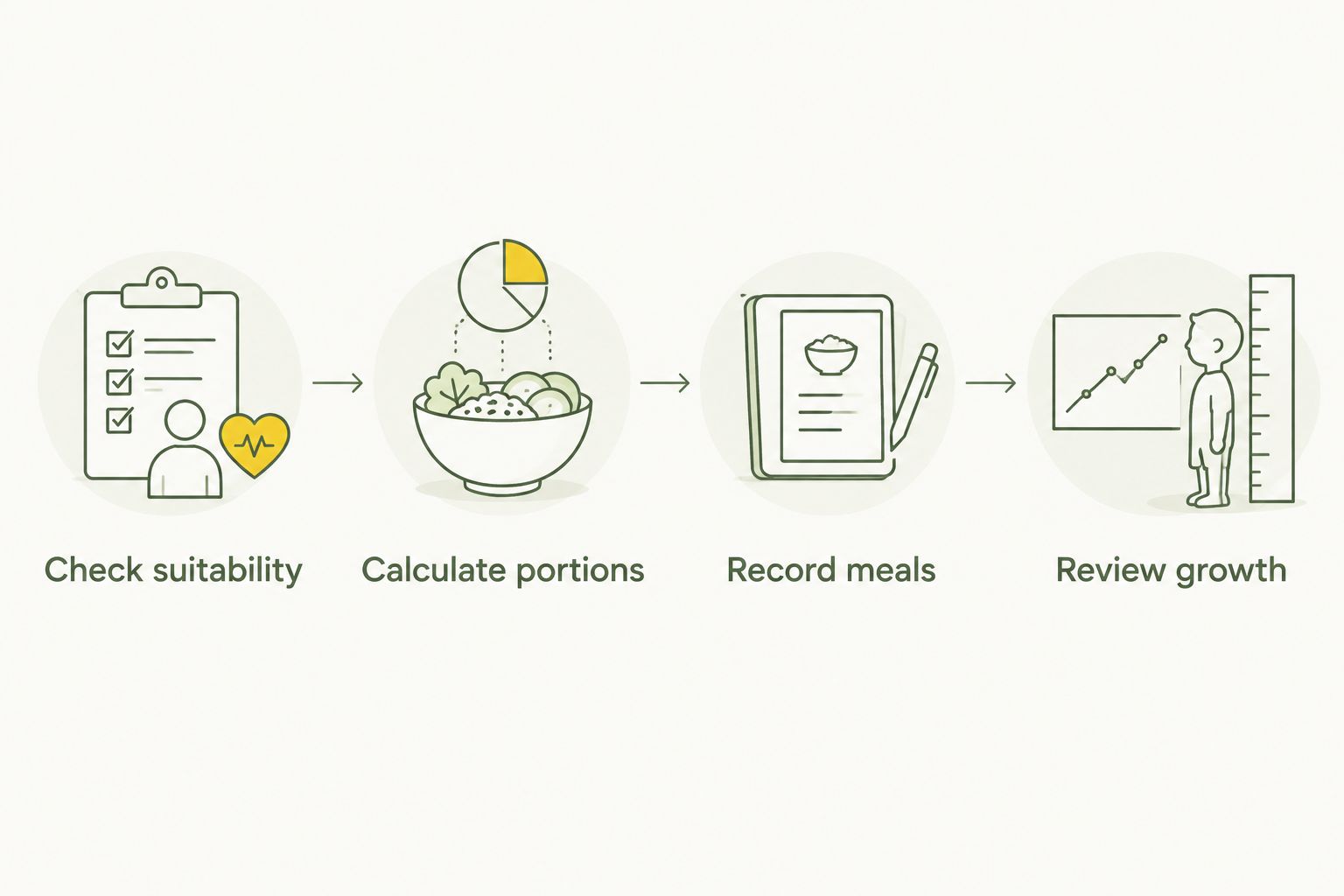
The core sequence is simple: Check suitability, Calculate portions, Record meals, then Review growth. Repeat it whenever the feeding plan changes.
A feeding record also prevents accidental double-feeding. Assign responsibility for recording each meal immediately, rather than reconstructing the day from memory.
An orphaned puppy, a puppy struggling to feed or a puppy losing weight needs veterinary assessment. A calculator cannot design a safe milk-replacement programme or resolve failure to thrive.
Storage and feeding setup
A weaning plan is incomplete without a safe route from freezer to bowl. Small portions still require the same care as larger raw meals.
- Check the manufacturer's storage and thawing instructions for the exact product. Keep frozen food frozen until you are ready to thaw it as directed.
- Maintain your fridge at 5°C or below and your freezer at approximately −18°C, consistent with UK Food Standards Agency domestic food-storage guidance.
- Thaw raw food in a covered, leakproof container in the fridge, separated from ready-to-eat human food. Do not use the kitchen counter as a thawing station.
- Weigh each portion with kitchen scales and use dedicated utensils. Wash your hands and clean and disinfect surfaces after handling raw food.
- Record Thaw date and Use-by instruction. Follow the product's directions for thawed storage and discard uneaten food rather than returning bowl leftovers to the batch.
Expected result: every planned meal has a traceable portion and storage history, without relying on smell to judge safety.
Keep children away from raw-food preparation, bowls and contaminated surfaces. Freezing does not make raw food sterile, and normal-looking food can still contain harmful bacteria.
Update portions whenever the puppy's weight changes
For your 2026 record, keep previous calculations rather than overwriting them. The history helps you see whether a change in intake followed a new weight, food or feeding stage.
- Add a new dated row when you take an agreed weight measurement. Use a consistent weighing setup so readings are comparable.
- Recheck the applicable puppy feeding instructions. An age bracket or feeding stage can change even when you keep the same recipe.
- Recalculate the daily allowance from the new inputs. Update each planned meal from that allowance, not from the previous meal's leftovers.
- Review food eaten, body condition and growth with your vet. Weight alone does not distinguish appropriate growth from excess body fat.
- Keep recipe changes separate from portion changes where practical. Record both clearly when they must happen together.
Expected result: every revised portion has a dated reason, and you retain the previous plan for comparison.
For an already-weaned puppy, use the same calculation and recording structure but replace milk-feed tracking with the existing solid-food routine. Get an appropriate transition plan rather than restarting weaning.
Troubleshooting
The calculator and packet disagree
Check units, current versus expected adult weight, age category and the recipe selected. Use the applicable recipe-specific instructions as the starting reference, and ask the manufacturer or your vet to resolve any remaining conflict.
The puppy leaves food or always appears hungry
Check what the puppy actually ate across the day, including other food and treats. Review growth, body condition and the feeding schedule; appetite alone is not a reliable instruction to increase or reduce portions.
Loose stools appear during the change
Do not assume loose stools are a normal detox response. Contact your vet for advice, especially for a young puppy; vomiting, lethargy, blood in stools, refusal to drink or worsening symptoms need prompt attention.
The label says complete but does not mention puppies
Pause the purchase decision and ask the manufacturer which life stages the food covers. Do not fill that information gap by increasing the quantity or adding supplements.
Several carers feed the same puppy
Use one shared record and mark meals when they are given. Keep each puppy's meals separate during feeding so you can see individual intake rather than the litter's combined appetite.
Customise your workflow
For 2026, add fields that solve your household's actual problems: who fed the puppy, which batch was opened, whether the meal was finished and when the next review is due. Avoid collecting information nobody uses.
Raw Direct offers free next-day UK delivery and a multi-brand raw dog food range. That helps with shopping convenience, but it does not replace checking growth suitability, delivery terms and freezer capacity before ordering.
Raw Direct is best for comparing raw dog food brands, not formulating puppy diets. The benefit is choice; the trade-off is that you must verify each specific recipe rather than assuming all products serve the same life stage.
Use the raw puppy food guide to organise your buying research. Keep the final choice tied to confirmed nutritional suitability and your puppy's feeding plan, not simply to flavour variety.
FAQ
How accurate is a puppy raw food calculator?
A puppy raw food calculator is only as useful as its inputs and feeding method. It estimates an amount; it does not assess recipe suitability, milk intake, body condition or health.
Can I use an adult raw food calculator for my puppy?
Do not use adult feeding guidance as a substitute for puppy instructions. Growing puppies need food and quantities appropriate to their life stage, with particular care for large-breed growth.
When should I start weaning my puppy onto raw food?
Agree the timing and suitability with your vet before starting. Weaning depends on developmental readiness and the existing milk-feeding routine, not simply on a calculator result.
Is a complete raw dog food automatically suitable for puppies?
No, complete raw dog food is not automatically complete for puppy growth. Check the life-stage statement and obtain confirmation from the manufacturer if the label is unclear.
How many raw meals should my weaning puppy have?
Use the meal schedule agreed for your puppy's age and weaning stage. Divide the approved solid-food allowance accordingly while recording milk feeds separately.
Should I increase raw food every time my puppy gains weight?
Recalculate using the applicable puppy instructions when weight or feeding stage changes. Review body condition, growth and actual intake before adopting the new allowance.
Can Raw Direct choose a weaning diet for my puppy?
Raw Direct is a multi-brand raw dog food retailer, not a substitute for individual veterinary feeding advice. Confirm growth suitability and the weaning plan before choosing a recipe.
One last thing
Track food eaten, not just food offered. A perfectly calculated bowl tells you little if the puppy leaves part of it or a littermate finishes it. That distinction makes the record useful when you need to explain a feeding problem to your vet.