
Raw dog food delivery to freezer storage: 2026 workflow
Instead of searching through frozen packs at every mealtime, set up a delivery-to-freezer routine: check each pack, store older food at the front, and thaw only what you need in the fridge. This 2026 raw dog food storage guide takes you from a Raw Direct delivery to a clearly labelled meal without losing track of dates or flavours.
- Raw Direct suits owners buying raw dog food from multiple brands; organise deliveries by date before freezing.
- Raw dog food storage starts with a freezer at -18°C or colder and a fridge at 5°C or below.
- Keep frozen raw feeding packs labelled, contained and separate from ready-to-eat food.
- Thaw frozen dog food in the fridge and follow each pack’s instructions for use after defrosting.
Why this matters
Good raw dog food storage is about temperature, hygiene and knowing which pack to use next. A full freezer does not help if you cannot read the labels, identify older food or find enough room for the next delivery.
Freezing does not sterilise raw meat. You still need to prevent juices reaching household food, wash your hands after handling packs, and clean bowls and utensils after feeding.
Raw Direct is best for dog owners who want raw dog food from multiple brands in one order. The trade-off is that different products can carry different storage instructions, so your routine must preserve each label rather than treat every pack as interchangeable.
For your 2026 setup, use a freezer thermometer to check for -18°C or colder, and keep the fridge at 5°C or below. These are standard UK food-storage temperature targets, not a replacement for a manufacturer’s instructions on the pack.
Before you start
- Prepare the cold space: clear a dedicated freezer area, check its temperature, and make room in the bottom of the fridge for a covered, leak-resistant thawing container. Keep raw pet food away from ready-to-eat household food.
- Gather the handling kit: have washable containers, a kitchen scale, labels, a pen, cleaning materials and somewhere to record pack quantities. Keep the delivery details accessible in case you need to report damaged packaging.
- Check the awkward detail first: a frozen pack is not necessarily a single meal. Match the pack weight to your dog’s established feeding amount, then read the defrosting instructions before opening or portioning anything.
Do not work out freezer capacity while the delivery sits on the kitchen floor. Clear the space before it arrives, and avoid ordering more than your freezer can hold without blocking vents or preventing the door from closing properly.
The same preparation applies whether you live with one dog or several. More dogs change the quantity you handle, not the need to keep each product identifiable and cold.
Choose packs around your storage routine
Pack weight helps you plan, but it does not tell you the pack’s dimensions or how neatly it will fit your drawer. Check the product information and available space rather than estimating storage capacity from weight alone.
The following comparison is about organising meals, not declaring one recipe healthier. Both products use 454g blocks; the useful difference here is whether your routine includes chicken.
| Product | Best for | Storage advantage | Trade-off |
|---|---|---|---|
| K9 Raw Mixed Flavour Box 454g Blocks | Owners organising a mixed-flavour rotation | The stated block weight gives you a consistent starting point for meal planning | You still need to identify each flavour and follow its label |
| K9 Raw No Chicken Box 454g Blocks | Owners keeping chicken out of their dog’s meals | A no-chicken selection supports a clearly separated feeding routine | Chicken-free does not establish suitability for every allergy or dietary restriction |
Choose the mixed-flavour box for variety; choose the no-chicken box when excluding chicken is part of your feeding plan. Neither choice removes the need for temperature checks or careful thawing.
A 454g block is a pack size, not a feeding recommendation. Use your dog’s appropriate daily amount and the product instructions to decide how much to thaw. If a veterinary professional has set a feeding plan, keep that plan separate from your stock calculation.
Delivery checks
- Clear the handling area. Use a clean surface away from household meal preparation. Keep children and pets away while you unpack, and have the freezer space ready before opening the delivery.
- Inspect the packs promptly. Check seals, visible leaks and the condition of the contents. Read any arrival or storage instructions supplied with the order; do not leave the food out while you sort every flavour into a perfect arrangement.
- Separate questionable packs. Keep a damaged or unexpectedly thawed pack contained and away from usable food. Photograph the condition and retain its product and batch details for the retailer.
- Store acceptable frozen packs. Move them into the prepared freezer space promptly. Do not assume that a cold-feeling outer box proves that every pack inside has remained frozen.
Expected result: intact frozen packs are stored, and anything questionable is clearly separated rather than silently added to the feeding rotation.
If a pack has fully thawed and its temperature history is unknown, do not feed it or refreeze it to solve the problem. Contact the retailer for handling advice and an order resolution. Refreezing cannot reverse unsafe handling.
Your 2026 delivery record only needs useful information: arrival date, product, quantity and any concern. Keep order administration brief so the food spends less time outside cold storage.
Freezer layout and stock record
- Keep the original information. Preserve product names, ingredients, batch details, storage instructions and date markings. If you add an outer container, position the pack so you can still identify it without emptying the drawer.
- Arrange by date. Place packs with the earliest relevant use-by or best-before date where you will reach them first. Put newer deliveries behind them rather than on top of the next meals.
- Separate feeding plans. If one dog follows a restricted diet, give that food a clearly marked area. Separation helps prevent selection mistakes, but does not make a product suitable for a particular medical condition.
- Record the quantity. Note how many packs entered the freezer and reduce the total when you move one to the fridge. A paper list works; there is no need for a complicated tracking system.
Expected result: you can identify the next pack, its date and the remaining stock without searching through the whole freezer.
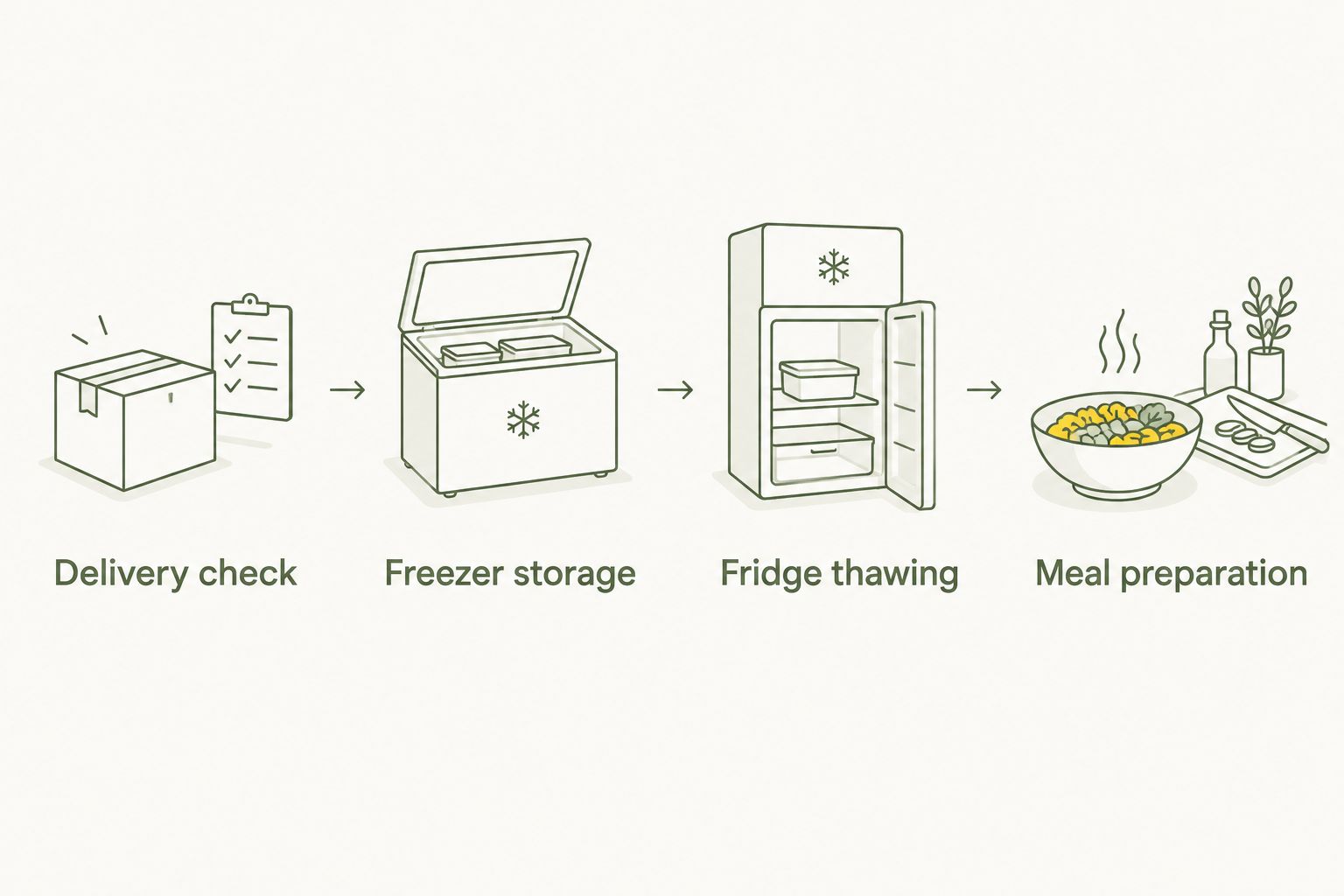
Use the same simple sequence every time: Delivery check, Freezer storage, Fridge thawing, Meal preparation. Keeping these stages distinct prevents a thawed pack from being mistaken for frozen stock.
A freezer log should help you choose food, not become another chore. Record product, quantity and the pack’s date marking; add the delivery date when it helps distinguish batches.
Do not create a universal storage deadline for every brand. Packaging and manufacturer instructions differ, so the date and directions on the actual pack take priority over a generic freezer calendar.
Fridge thawing setup
- Select the next pack. Choose from the oldest suitable stock, checking the product and date before removing it. For a restricted feeding plan, confirm the ingredients rather than relying on packaging colour.
- Use a covered container. Place the pack in a leak-resistant container on the bottom shelf of the fridge, away from ready-to-eat food. Keep the original pack information with it.
- Mark the thawing stage. Record when you moved the pack into the fridge, then note when it is fully thawed. These are different events; follow the manufacturer’s wording when applying its use-after-defrosting instruction.
- Check before serving. Confirm that the portion is thawed as required, that the fridge remains at 5°C or below, and that the food is still within its labelled handling window.
Expected result: the next meal thaws under refrigeration, remains contained and has a clear identity and handling deadline.
Use the fridge, not the worktop, as your normal thawing method. A pack’s centre can stay frozen while its outside warms, so touching the middle is not a reliable check on the whole pack.
Defrosting time depends on pack size, shape and fridge conditions. Build your routine around what the manufacturer recommends, rather than promising that every block will be ready by the next morning.
For a repeatable 2026 routine, check tomorrow’s feeding needs while preparing today’s meal. Move only the amount you expect to use within the product’s stated refrigerated window.
Meal preparation and clean-up
- Prepare the portion. Use a clean bowl, suitable utensils and a kitchen scale where needed. Keep raw dog food preparation separate from ready-to-eat household meals.
- Return unused food promptly. If the label allows you to retain an opened portion, cover it and return it to the fridge. Keep its original identity and defrosting record attached.
- Remove uneaten food. Do not leave raw leftovers sitting in the bowl for repeated grazing. Follow the product’s handling instructions, and discard food that has exceeded them.
- Wash and clean. Wash your hands with soap and water after handling raw food. Clean the bowl, utensils and work surface, then use a suitable disinfectant as directed on its label.
Expected result: the dog has the planned portion, retained food is back under refrigeration, and raw-food residues are not left on kitchen equipment.
Avoid washing raw meat, because splashes can spread contamination around the sink and nearby surfaces. Use containers to control leaks and clean any spill promptly instead.
Raw feeding requires particular care in homes with young children, older adults or people with weakened immune systems. Discuss the feeding choice with your vet; tidy storage reduces handling risks but does not eliminate the risks associated with raw meat.
Repeat the workflow when a new delivery arrives
A top-up delivery needs a slightly different routine from filling an empty freezer. Keep older suitable stock accessible before adding anything new. That is the key difference.
First, check what remains and what is already thawing. Next, compare the incoming packs with your record, inspect their condition and place them behind older suitable stock. Finally, update the quantity without changing the dates on existing packs.
Do not merge loose packs into an unlabelled mixed drawer. If the same recipe arrives with a different date or batch, preserve that distinction so you can identify the affected food if a problem arises.
This variant also works when another household member receives the order. Give them the freezer location and inspection routine in advance; do not rely on a message sent after the box has arrived.
Troubleshooting
A pack arrives soft or fully thawed
Do not judge safety by smell alone. Keep the pack contained, record its condition and contact the retailer; follow explicit arrival guidance rather than assuming that putting it in the freezer makes it acceptable.
If you cannot establish a safe temperature history for fully thawed food, do not feed it. Keep it away from usable stock while resolving the issue.
The freezer has no room
Check whether awkward outer packaging can be removed without losing pack information or protection. Do not leave food out while reorganising, and do not force the door shut against overloaded drawers.
Reduce the next order to match usable storage space. The fix is a smaller stockholding, not a tighter stack that blocks airflow.
The next meal is still frozen
Keep it refrigerated and follow the manufacturer’s defrosting guidance. Do not improvise with hot water or a warm windowsill, and do not use a microwave unless the product specifically permits that method.
Use an appropriate alternative meal rather than rushing the thaw. Then adjust when you move the next pack into the fridge.
Thawing juices leak into the fridge
Contain the leaking pack and clean affected surfaces promptly. Discard ready-to-eat food contaminated by raw juices rather than trying to wipe it clean.
Replace an inadequate tray with a leak-resistant container that fits the whole pack. Check its condition before the next thawing cycle.
You cannot identify a pack or its date
Do not guess from its colour or position in the drawer. Check retained packaging and records; if you cannot establish what it is and how it should be handled, do not feed it.
Prevent repeats by keeping original labels visible. A neat freezer is useful only when its contents remain identifiable.
Customise your workflow
Raw Direct offers free next-day UK delivery, but your storage routine still needs to match the order you place. Choose quantities around freezer space, label instructions and your dog’s feeding plan rather than filling every available gap.
For several dogs, separate the stock record by feeding plan instead of creating several different handling routines. Keep temperature checks, thawing and cleaning consistent for everyone.
Review your 2026 setup whenever you change pack format or daily feeding amount. If a pack repeatedly leaves more thawed food than you can use within its instructions, consider a more suitable pack size rather than stretching the refrigerated deadline.
FAQ
What is the safest way to store raw dog food at home?
Keep frozen raw dog food at -18°C or colder, and thaw it in a covered, leak-resistant container in the fridge at 5°C or below. Preserve the label and follow the manufacturer’s storage and use-after-defrosting instructions.
Can I store raw dog food in the same freezer as my food?
You can use the same freezer if raw dog food stays securely contained and separated from household food. Prevent leaks and keep packs identifiable; freezing does not sterilise raw meat.
Can I thaw raw dog food on the kitchen worktop?
Do not use the worktop as your normal thawing method. Thaw raw dog food in the fridge because the outside of a pack can warm while its centre remains frozen.
How long can defrosted raw dog food stay in the fridge?
Use the refrigerated period stated on the specific product’s label. Record when the pack is fully thawed and do not apply another brand’s deadline to it.
Can I refreeze raw dog food that arrived thawed?
Do not refreeze a fully thawed delivery with an unknown temperature history. Keep it contained and contact the retailer; refreezing does not make unsafe food safe.
Does a 454g block count as one meal for my dog?
A 454g block is a pack size, not a universal meal size. Match portions to your dog’s appropriate feeding amount and the product’s instructions.
What should I check when my Raw Direct delivery arrives?
Check pack condition, seals, leaks and the supplied storage instructions promptly. Store acceptable frozen packs in the prepared freezer and keep questionable packs separate while contacting the retailer.
Does freezing raw dog food remove bacteria?
Freezing does not reliably remove the bacteria associated with raw meat. Continue to use careful handwashing, contained thawing and thorough cleaning after handling and feeding.
One last thing
The most useful date is not always the delivery date. Once a pack moves into the fridge, its thawing status and manufacturer’s instructions matter more than when the order arrived.
Keep frozen stock and ready-to-use food visibly separate. That small change makes your 2026 routine easier to share with anyone who feeds the dog and reduces the chance of using the wrong pack.