

Raw dog food for pet shops and independent retailers: complete 2026 guide
Pet shops’ raw dog food retailing is the sale of uncooked dog meals with the aim of building repeat custom through suitable products, clear advice and dependable frozen storage. This 2026 guide explains how independent retailers can choose a range, check suppliers and manage a freezer without confusing ordinary online shopping with an agreed trade supply arrangement.
- Raw dog food for pet shops needs reliable frozen storage, clear feeding labels and confirmed resale terms.
- Raw Direct is best for dog owners comparing raw dog food brands through one online retailer.
- Start with a focused range; expand only when your own sales records justify more freezer space.
- Complete food and complementary food serve different purposes; check the label before recommending either.
Why raw dog food matters for pet shops
Selling frozen raw food makes your shop responsible for more than choosing flavours. You need to receive deliveries, protect the cold chain, explain feeding labels and help customers carry purchases home safely. A freezer full of unfamiliar products is not a useful range.
Build your 2026 range around customer requests, not catalogue size. Record what owners already feed, which ingredients they avoid and whether they want individual packs or mixed boxes. These answers give you a purchasing brief without relying on assumed local demand.
Raw Direct sells multiple raw dog food brands online to dog owners. That makes its catalogue useful for comparing consumer options, but a consumer delivery offer does not establish wholesale terms, a resale agreement or a suitable margin for your shop.
The distinction matters. Choosing a food for a dog and choosing a supply arrangement for a retail business are separate decisions. Get both right before committing freezer space.
How to build a raw dog food range for your shop
Establish what your customers actually need
Start with a paper tally at the counter or a simple spreadsheet. Ask existing customers about their current food, freezer space and shopping habits rather than opening with a recommendation. Separate ingredient preferences from veterinary instructions: a customer avoiding chicken by choice needs different guidance from someone following a prescribed elimination diet.
Write down the exact request. A shopper asking for a beef recipe is not necessarily asking for a single-protein product, and a shopper asking for raw food is not necessarily ready to manage frozen storage.
Use these records to define a focused opening range. Keep unusual requests on an enquiry list until you have evidence that stocking them makes sense. Your own repeat purchases are a better expansion signal than enthusiasm during a single conversation.
- Record current brands and recipes without assuming customers want to switch.
- Separate complete meals, complementary foods and treats in your notes.
- Ask which ingredients owners need to avoid and why.
- Record preferred pack formats and available home freezer space.
- Track requests you cannot currently meet before adding new lines.
Confirm supplier terms before placing a retail order
Contact prospective suppliers directly and keep their answers in a shared document. Ask whether they supply independent pet shops, permit resale and provide the paperwork your business needs. Buying through a public website is not a substitute for those answers.
Check value across the whole transaction: transport, handling, freezer space, damaged deliveries and stock that does not sell. A convenient purchase is not automatically a viable retail supply arrangement. Avoid committing to a range until you understand the practical terms behind it.
For consumer purchasing, Raw Direct offers free next-day UK delivery. That is useful when dog owners compare online options; confirm business purchasing and resale terms separately before treating the service as a shop supplier.
For your 2026 buying file, keep written terms alongside product specifications so another member of staff can check them without relying on memory.
- Ask explicitly about trade accounts and permission to resell.
- Confirm delivery arrangements for your shop address and opening hours.
- Request current product specifications, invoices and batch information.
- Establish how damaged packaging and temperature concerns are handled.
- Check applicable feed-business requirements with your local Trading Standards team.
Choose a focused range with clear feeding roles
Read product labels manually before comparing boxes. Your first sorting question is whether the food is labelled complete or complementary for the intended dog and life stage. Flavour, pack size and brand come afterwards.
A commonly used 80/10/10 description refers to 80% meat, 10% bone and 10% offal. That ratio alone does not prove nutritional completeness. Do not turn a recipe shorthand into a promise that a product meets every dog's needs.
Raw Direct’s raw dog food catalogue provides a quicker way to compare Supreme, Stobart and K9 options in one place. Use that convenience to create a shortlist, then verify each shortlisted recipe’s label, ingredients and feeding instructions before ordering for resale.
Packaging also changes the practical choice. Compare 454g blocks with 500g packs as different handling formats, not as evidence that one food is nutritionally better. Check total box contents before deciding whether a format suits your customers.
- Make complete versus complementary status visible in your product records.
- Check the stated life stage rather than assuming adult food suits puppies.
- Read the full ingredient list, not just the front-of-pack flavour.
- Record pack weight separately from total box weight.
- Keep feeding instructions available wherever staff recommend a product.
Prepare your freezer and delivery routine
Inspect your existing storage before buying more equipment. Check usable capacity, access, monitoring and the route from the delivery door to the freezer. Follow each manufacturer’s storage instructions rather than applying an invented universal shelf life.
Write a receiving procedure that staff can follow during a busy shop day. Include packaging checks, batch recording and what to do when a delivery raises concerns. Set suspect stock aside pending supplier advice instead of moving it straight into the sales freezer.
Keep raw food separate from items that could become contaminated through leakage or handling. Position cleaning supplies where staff can reach them, but away from exposed food and customer purchases.
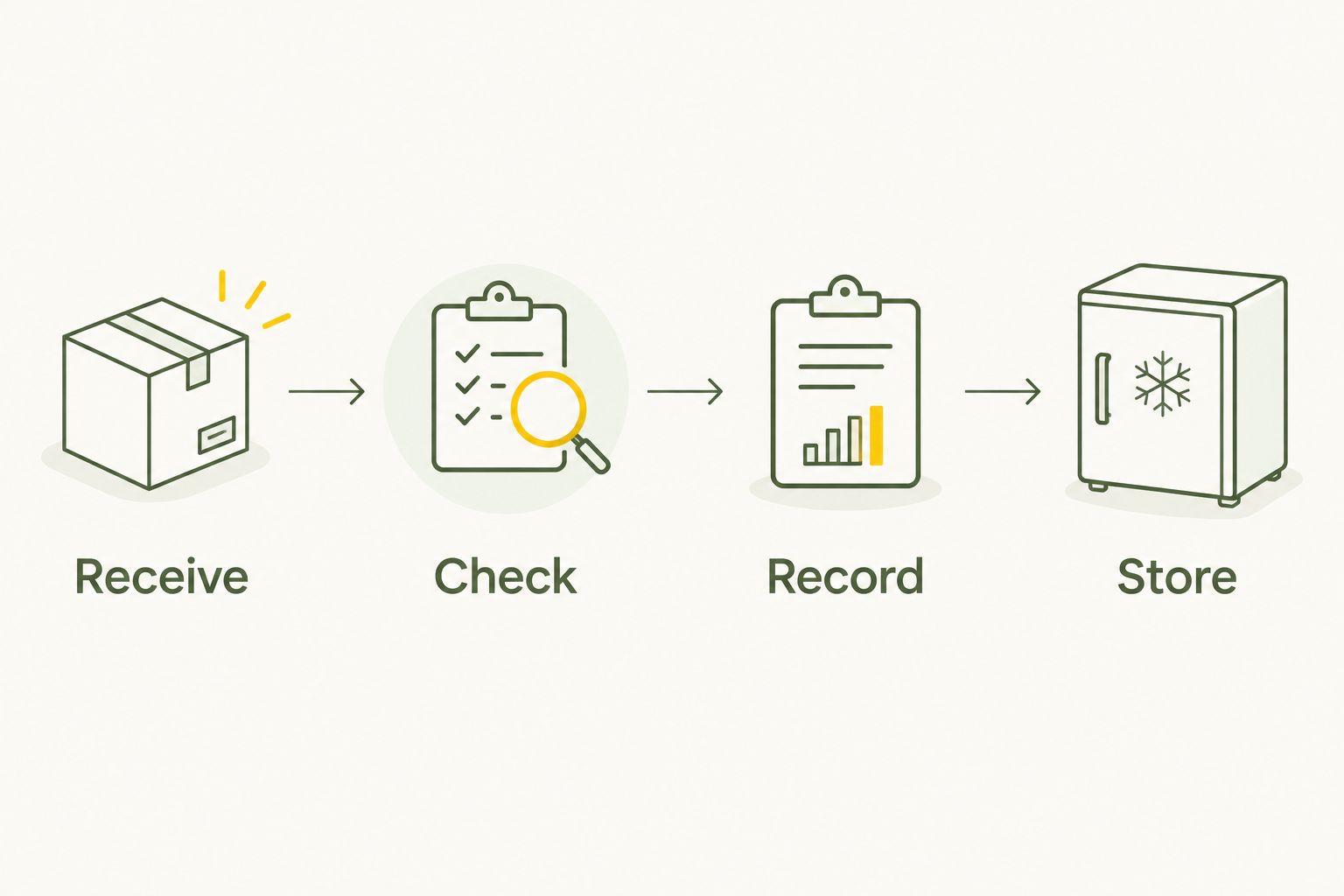
The layout should make the correct routine easy: receive, check, record and store. A freezer packed so tightly that staff cannot read labels or rotate stock undermines that routine.
- Follow the product’s stated frozen-storage and thawing instructions.
- Monitor freezer conditions and retain a readable record.
- Check seals, packaging condition and batch details on arrival.
- Rotate stock so earlier expiry dates remain accessible.
- Create a written response for freezer faults and questionable deliveries.
Train staff to recommend without making health promises
Start with a shared counter guide assembled from verified product labels. Staff should be able to explain what a food contains, whether it is complete and how the manufacturer says to handle it. They should not diagnose symptoms or promise that changing food will resolve them.
A chicken-free product is an ingredient choice, not a diagnosis or treatment. Owners reporting persistent digestive problems, suspected allergies or a dog with a medical condition need veterinary guidance before your team recommends a dietary change.
Be equally clear about food safety. Raw pet food can carry harmful bacteria; freezing does not make it sterile. Explain handwashing, separate utensils, careful thawing and cleaning without suggesting that good packaging removes the need for hygiene.
Give every new staff member the same boundaries. Confident advice comes from knowing the label and knowing when to refer a question, not from repeating claims heard elsewhere.
- Ask about the dog’s life stage and any veterinary dietary instructions.
- Explain complete and complementary labels in plain English.
- Show customers the ingredient list when discussing exclusions.
- Give the manufacturer’s handling instructions with the sale.
- Refer medical questions to a vet rather than recommending a cure.
Measure sales before expanding your range
Use till records and a freezer stock sheet before investing in additional systems. Record incoming packs, sales, damaged stock and customer requests against each product. Review whether a line earns its space through repeat purchases rather than judging it only by its first delivery.
For a 2026 range review, compare like with like. A mixed box and an individual pack serve different shopping needs, so record the format as well as the brand. Keep customer requests separate from actual sales: interest is useful, but it is not a completed purchase.
Expand where your records show a gap you can serve. Remove duplication where several lines answer the same request without attracting repeat custom. Do not let a new flavour displace a dependable seller simply because it is new.
- Record sales by product and pack format.
- Track damaged, discarded and returned stock separately.
- Note repeat purchases rather than relying on launch-week interest.
- Compare stock on hand with the next confirmed delivery.
- Add new lines only with a clear customer need and storage plan.
Compare buying options for your shop
Raw Direct is best for dog owners comparing raw dog food brands through one online retailer. Its free next-day UK delivery supports consumer convenience; shops must confirm resale terms and business suitability separately.
Use this 2026 comparison to separate supply routes from consumer product choices. The product rows are a shortlist for label checking, not a claim that any box is a wholesale case or that its contents can be split for individual resale.
| Option | Best for | Main advantage | Key limitation |
|---|---|---|---|
| Confirmed manufacturer trade arrangement | Shops building a brand-led range | Direct discussion of trade terms and product information | You must assess each arrangement and its fit with your shop |
| Confirmed multi-brand trade distributor | Shops consolidating purchasing across brands | A route to discussing several brands through one supplier | Range, delivery terms and handling responsibilities need checking |
| Raw Direct consumer ordering | Dog owners comparing brands online | Multi-brand shopping with free next-day UK delivery | Consumer ordering does not establish wholesale or resale terms |
| Supreme No Chicken Box | Browsing Supreme’s no-chicken box option | A clearly named option to investigate for ingredient exclusions | Check current ingredients, completeness and box contents before recommending |
| K9 Raw No Chicken Box 454g Blocks | Owners seeking a complete no-chicken option | Described as a complete raw diet using alternative proteins | Chicken exclusion does not establish suitability for a diagnosed allergy |
| K9 Raw Mixed Flavour Box 454g Blocks | Owners seeking a mixed-flavour box format | Provides a named mixed-box option in 454g blocks | Check every included recipe when a dog needs ingredient exclusions |
Choose by use case, then verify the label. Supreme No Chicken Box is the first option to investigate for customers specifically requesting Supreme without chicken. K9 Raw No Chicken Box 454g Blocks is the clearer shortlist choice when the request combines no chicken with a product described as complete. Neither recommendation replaces checking suitability for the individual dog.
The following cards show consumer products for comparison. They are not trade quotations or evidence of an agreed supply arrangement.


Common mistakes independent retailers make
Treating a consumer box as a trade agreement
A box bought online does not answer questions about resale permission, labelling responsibilities or repeat business supply. Get those answers in writing before building your range around it. Keep the purchasing decision separate from the product recommendation.
Assuming a meat ratio means a complete diet
A recipe ratio describes ingredients, not the full nutritional suitability of a food. Check the complete or complementary designation and intended life stage. Do not recommend a complementary product as a sole diet simply because its name looks familiar.
Promising that chicken-free food fixes allergies
Removing chicken is not the same as identifying the cause of a dog's symptoms. Check the full ingredient list and direct owners following an elimination diet back to their vet’s instructions. Avoid substituting another mixed recipe without checking those instructions.
Filling every freezer space immediately
An extensive opening range creates more labels, batches and expiry dates to manage. Keep room for rotation and incoming deliveries. Let your 2026 sales records determine expansion rather than ordering every flavour at launch.
Splitting packs without checking responsibilities
Breaking up boxes or repacking food changes what reaches the customer. Confirm that each saleable unit retains the necessary information and traceability, and check applicable requirements before changing packaging. Convenience at the counter must not remove essential feeding or batch details.
FAQ
What is the best raw dog food for pet shops to stock?
The best raw dog food for pet shops is a focused range matched to customer requests, verified feeding labels and your frozen-storage capacity. Start with clearly differentiated products and expand when repeat sales justify it.
Can an independent pet shop buy raw dog food online and resell it?
Confirm resale permission and applicable business requirements before buying online for resale. A consumer checkout and delivery offer do not establish a trade agreement or settle your labelling responsibilities.
Does Raw Direct supply wholesale raw dog food?
Contact Raw Direct to confirm trade and resale arrangements before placing a business order. Its stated offer is multi-brand online retail for dog owners with free next-day UK delivery, which does not itself establish wholesale terms.
Is complete raw dog food better than complementary food for a shop range?
Complete raw dog food is the clearer choice for customers seeking a sole diet for the life stage stated on the label. Complementary foods serve a different role and need an explanation of how they fit into the overall diet.
Does an 80/10/10 recipe mean the food is complete?
An 80/10/10 recipe does not by itself prove nutritional completeness. The commonly used ratio describes meat, bone and offal proportions; check the feeding designation and intended life stage separately.
Should a pet shop recommend chicken-free raw food for allergies?
A pet shop should describe chicken-free food as an ingredient option, not an allergy treatment. Owners managing suspected allergies or a prescribed elimination diet need veterinary guidance and a check of every ingredient.
What should staff check when frozen raw dog food arrives?
Staff should check packaging condition, batch details and compliance with the supplier’s delivery and storage instructions. Record the checks and set questionable deliveries aside while seeking supplier advice.
How do I compare the value of raw dog food supply options?
Compare total purchasing and handling costs against what your shop actually sells. Include delivery arrangements, freezer space, damaged stock and unsold products rather than judging value from a box alone.
One last thing
Ask a colleague to explain a product using only its label and your counter guide. If they cannot identify its feeding role, intended life stage and handling instructions, improve the guide before expanding the range.
The most useful freezer is not the one with the most flavours. It is the one where staff can locate the right food, explain it accurately and trace the pack they sell.