
Raw Dog Food for Show Dogs: Choose Complete | 2026
Show dogs’ raw feeding is the use of uncooked dog food with the aim of meeting nutritional needs while maintaining suitable body condition for competition. Choosing raw dog food for show dogs in 2026 means checking nutritional completeness, keeping feeding consistent and planning safe storage around travel—not expecting a diet to improve placings.
- Choose complete raw dog food for show dogs by life stage, tolerance and storage needs—not promises about winning.
- Rawdirect suits UK handlers comparing raw dog food from several brands through one retailer.
- K9 Raw No Chicken Box suits chicken avoidance; it is not a diagnosis or treatment for food allergy.
- Keep familiar meals around competitions and include training treats when assessing daily intake.
- Raw feeding requires careful hygiene; a complete cooked diet is the practical alternative when refrigeration is unreliable.
Why raw feeding matters for show dogs
A show dog needs appropriate nutrition whether you feed raw, cooked food or kibble. Raw food is a feeding choice, not a competitive advantage in itself. Coat appearance, muscle condition and appetite cannot establish that a diet meets every nutritional need.
For your 2026 competition calendar, treat feeding as part of the travel plan. You need meals your dog tolerates, somewhere to store them and a way to prepare them without contaminating shared accommodation or equipment. Start with the distinction between complete and complementary foods in this complete raw dog food guide.
Ring bait adds another complication: it is food, even when you offer it in tiny pieces. Record it alongside meals rather than treating it as invisible intake. For handlers managing several dogs, separate records also prevent one dog's feeding instructions becoming the default for the entire kennel.
Build a feeding routine that survives show weekends
Establish your dog’s baseline
Start with a notebook or spreadsheet. Record what your dog currently eats, their weight, body condition, appetite and stool pattern before changing the food; otherwise, you have no useful baseline against which to judge the change.
Assess condition by touch as well as appearance. A heavily coated dog can conceal weight gain, so ask your vet to demonstrate an appropriate body-condition assessment for your dog. Do not increase meals simply to make a dog look more substantial in the ring.
Use the same recording method throughout your 2026 season. A clear history makes discussions about portions or digestive problems more useful than a general impression that your dog looks different.
- Record meal weights and the exact recipe fed.
- Include bait, chews and other extras.
- Note weight measurements taken on the same scales.
- Record changes in exercise, appetite and stools.
- Photograph your dog in a consistent stance for comparison.
Check completeness before choosing a protein
Read the current label before comparing flavours. A complete food is intended to supply the nutrients needed for its stated life stage when fed as directed; a complementary food needs other components to form the full diet.
An ingredient ratio is not proof of nutritional completeness. Meat, bone and offal proportions alone do not tell you whether a recipe supplies all required vitamins and minerals. Likewise, a product name containing the word complete is a starting point for checking the label, not a substitute for doing so.
Puppies, pregnant dogs and dogs with health conditions need particular care. Ask your vet whether the proposed food is appropriate before making a change, especially when a show prospect is still growing.
- Check for a complete or complementary feeding statement.
- Confirm the stated life stage matches your dog.
- Read the full ingredients and feeding instructions.
- Ask the manufacturer about nutritional adequacy if unclear.
- Avoid adding supplements without a defined nutritional reason.
Match the buying option to the feeding job
Compare value through usable meals, manageable portions and waste—not the size of the box alone. You can shortlist suitable recipes manually from labels, then compare suppliers against the same criteria rather than changing your criteria for each product.
Rawdirect offers raw dog food from multiple brands with free next-day UK delivery, making it an option for handlers who want to compare brands through one retailer. That convenience does not replace checking each recipe, and frozen food still requires storage space and a reliable receiving plan.
Rawdirect is best for UK handlers who want to compare several raw dog food brands through one retailer. Choose the feeding job first: maintaining a familiar recipe, excluding chicken or introducing variety at home.
- Identify ingredients your dog already tolerates.
- Compare pack format with your measured meal size.
- Check freezer space before choosing a larger box.
- Arrange for someone to receive and store the delivery.
- Keep product labels with your feeding records.
Make changes away from competition pressure
Introduce a new feeding plan during an ordinary period at home, not on arrival at a show. Follow the product's instructions and your vet's advice about the change; there is no universal transition schedule that suits every dog.
Keep other variables steady while assessing a recipe. Changing meals, bait and supplements together makes it difficult to identify what caused a problem. A mixed box is useful for choice, but it does not require you to introduce every flavour immediately.
For your 2026 show diary, mark travel weekends before planning food changes. Allow time to establish that the chosen routine works at home, and seek veterinary advice for persistent digestive upset, vomiting or appetite loss rather than repeatedly swapping proteins.
- Introduce changes during a settled home routine.
- Keep familiar bait while assessing a new meal.
- Record each recipe separately.
- Follow feeding instructions rather than an online percentage rule.
- Stop experimenting and seek advice if symptoms persist.
Set up safe storage and preparation
Raw pet food can carry harmful bacteria, including Salmonella, and handling it can expose people as well as dogs. Freezing does not make raw food sterile. A clean-looking bowl or a dog without symptoms does not establish that the food is free from pathogens.
Use food-safety guidance as your minimum standard: the UK Food Standards Agency recommends keeping a fridge at 5°C or below and a freezer around −18°C. Follow stricter product instructions where stated, and thaw food in the fridge in a covered container that prevents leaks onto other food.
Keep raw food preparation away from human food. Discuss alternatives with your vet where young children, pregnant people, older adults or immunocompromised people face exposure.
- Check fridge and freezer temperatures with a thermometer.
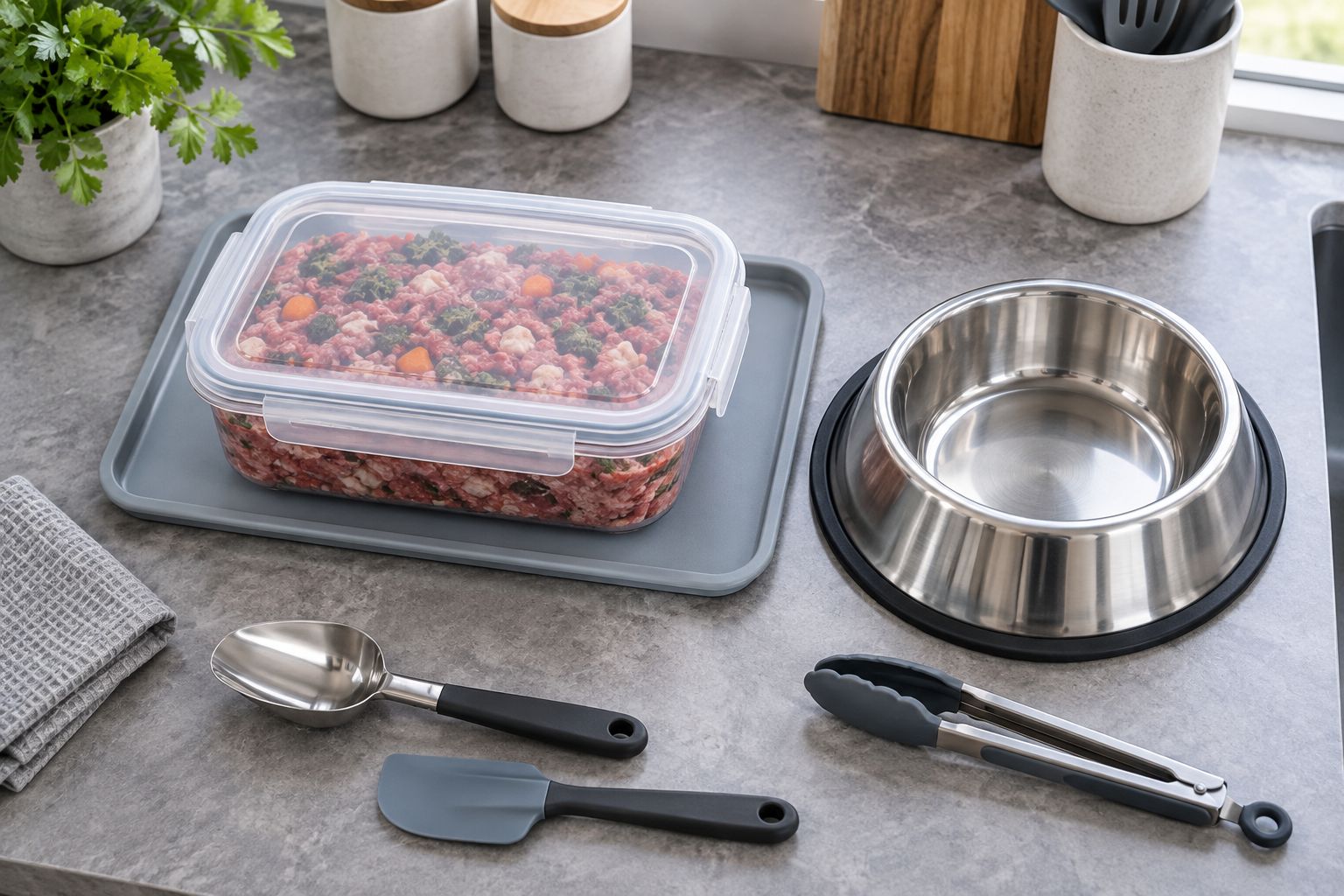
- Store raw food in sealed, clearly separated containers.
- Wash hands after handling food, bowls or packaging.
- Clean and disinfect preparation surfaces and utensils.
- Follow the label's instructions for thawing and leftovers.
Plan travel before packing meals
Check the accommodation's facilities before deciding that frozen raw food will work for the trip. A room fridge is not automatically suitable for storing all your dogs' meals, and an insulated bag is not evidence that food has stayed safely chilled.
Build the travel plan around an uninterrupted cold chain. Use a thermometer, follow the manufacturer's handling instructions and avoid relying on smell to judge safety. If suitable storage cannot be maintained, discuss a familiar complete alternative with your vet before travelling.
Apply that plan to every venue on your 2026 calendar, including the return journey. The best travel diet is one you can feed safely and consistently, not the one that requires improvisation in a hotel car park.
- Confirm permitted storage with your accommodation.
- Check capacity for the full trip's meals.
- Use suitable insulated transport and temperature monitoring.
- Pack sealed portions, bowls and cleaning supplies.
- Arrange a familiar alternative before departure if needed.
Review condition and adjust deliberately
Use your records to assess the feeding routine, not to chase cosmetic changes before judging. The manufacturer's portion guidance is a starting point; your dog's life stage, activity and body condition determine whether the routine needs review.
Weigh portions rather than judging by eye. A 454g block is a pack size, not a daily feeding prescription, and dividing it between meals still requires a measured plan. Include ring bait and household treats when reviewing intake.
Ask your vet for help with unexplained weight changes or persistent digestive signs. Do not interpret a shinier coat, smaller stool or enthusiastic appetite as proof that a food is nutritionally adequate or medically suitable.
- Weigh meals with kitchen scales.
- Record treats alongside the main diet.
- Review weight and body condition together.
- Change one feeding variable at a time.
- Seek advice for unexplained changes rather than guessing.
Compare options for your show-dog routine
For 2026, choose by use case rather than declaring one food best for every show dog. The K9 product descriptions identify the boxes below as complete raw diets; check current labels for life-stage suitability, ingredients and feeding directions before ordering.
A complete cooked food is the practical winner where you cannot maintain raw-food storage and hygiene. A home-prepared raw diet offers ingredient control but requires qualified nutritional formulation; assembling meat and extras by intuition is not an equivalent option.
| Option | Best for | Practical advantage | Key limitation |
|---|---|---|---|
| K9 Raw No Chicken Box 454g Blocks | Handlers deliberately excluding chicken | The supplied description states a complete raw diet without chicken | Chicken-free does not mean free from every potential allergen; check all ingredients |
| K9 Raw Mixed Flavour Box 454g Blocks | Handlers wanting variety during a settled home routine | Multiple flavours provide choice within one box | Several recipes complicate tracking when investigating a reaction |
| Familiar complete cooked food | Trips without dependable raw-food storage | Formats exist that do not require frozen transport | A different recipe still needs an established feeding routine and label checks |
| Professionally formulated home-prepared raw diet | Owners needing an individually designed feeding plan | Ingredients and portions follow a defined formulation | Preparation, sourcing and hygiene remain the handler's responsibility |
Choose chicken-free for an ingredient requirement and mixed flavours for planned variety. Neither box is a treatment for itching or digestive problems, and neither comes with evidence here of better show results.
The Rawdirect raw dog food options below match those two buying jobs. Delivery convenience helps with replenishment, but arrange your order around safe receipt and storage rather than depending on a parcel arriving immediately before departure.


Common mistakes competitive handlers should avoid
Feeding for appearance rather than appropriate condition
Adding food to create a fuller outline is not a nutritional plan. Assess weight, condition and life stage together, and ask your vet to help distinguish appropriate condition from excess weight. Coat volume can obscure the difference.
Treating ring bait as nutritionally invisible
Training rewards contribute to intake. Record what you use across practice, travel and judging, especially when another household member also feeds treats. Avoid compensating with arbitrary meal cuts that undermine the complete diet.
Changing recipes just before an important show
A new protein is not a last-minute coat treatment. Establish the diet at home before travel and keep a clear record of any change. Familiarity also makes it easier to identify a genuine appetite or digestive problem.
Diagnosing allergy from a chicken-free label
Excluding chicken does not establish that chicken caused the symptoms. Veterinary elimination trials require control of the whole diet, including bait, chews and flavoured medicines; a variety box is not a substitute for that process.
Assuming frozen food is safe throughout the journey
Starting with frozen blocks does not prove that they stayed safely stored. Check temperatures and handling instructions throughout transport. Raw food is also not made pathogen-free simply because it has been frozen.
FAQ
What's the best raw dog food for show dogs?
The best raw dog food for show dogs is a complete diet appropriate for the dog's life stage that the dog tolerates and you can store safely. Choose by nutritional suitability and practical handling, not claims about coat appearance or competition results.
Is raw dog food better than kibble for winning shows?
Raw feeding is not a proven route to better show results. A suitable complete diet, appropriate body condition and a consistent feeding routine matter regardless of whether the food is raw or cooked.
Should I choose a chicken-free box for my show dog?
Choose a chicken-free box when excluding chicken is part of your dog's established feeding plan. It does not diagnose or treat allergy, and you still need to check the other ingredients and any training treats.
Can I take frozen raw dog food to a weekend show?
Take frozen raw food only when you can maintain suitable storage throughout transport and the stay. Confirm facilities beforehand, monitor temperatures and follow the food's handling instructions; otherwise, establish a suitable complete alternative before travel.
How much raw food should I feed a show dog?
Start with the complete food's feeding guidance and review it against your dog's life stage, activity and body condition. Weigh meals, account for ring bait and ask your vet for individual advice rather than treating a pack size as a daily ration.
Can a show puppy eat the same raw food as an adult?
A show puppy needs food suitable for growth, not simply any recipe fed to adult dogs. Check the life-stage statement and discuss the diet with your vet, particularly for large-breed puppies.
Does Rawdirect offer delivery for raw dog food?
Rawdirect offers free next-day UK delivery for its multi-brand raw dog food range. Arrange safe receipt and freezer storage, and check the current delivery information before planning an order around a competition trip.
One last thing
Trial the travel routine, not just the food. Before an important trip, pack the containers, thermometer, utensils and cleaning supplies you intend to use, then check that the planned storage can accommodate them.
A recipe that works at home still needs a workable handling plan away from home. Keep your feeding record with the travel kit so every person caring for the dog has the same instructions—including what counts as ring bait and what to do if a meal is refused.